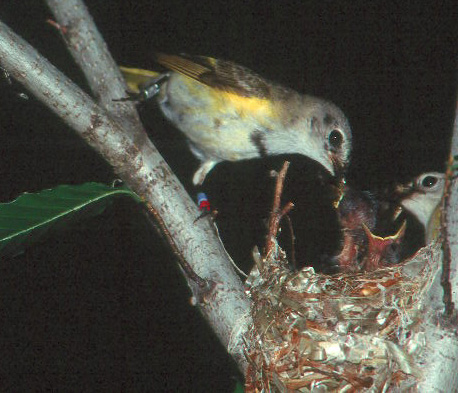

Bird Population Ecology,
Conservation Biology
4024 Percival Stern Hall
(504) 862-8296
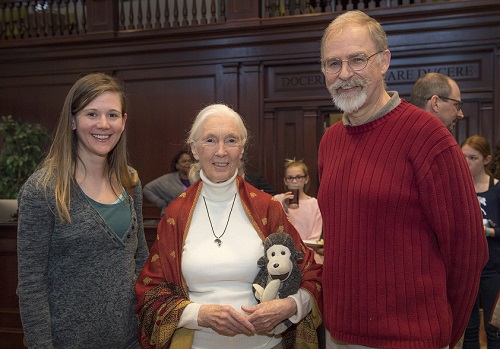
Dr. Sherry with Deborah Visco Abibou (recent Ph.D. from Sherry lab) and Jane Goodall, April, 2017
Research
My lab studies the population ecology, conservation, and
evolution of birds, especially (1) long distance migrants
between tropical and temperate ecosystems (particularly
Neotropical-Nearctic migrants), and (2) resident tropical
(Central American) species. We are interested in what controls
or limits populations, including food resources and competition,
predators, and dispersal barriers; and in human influences on
habitats and landscapes in North America and the Neotropics
(Caribbean, especially Jamaica, and Central America). We use a
combination of statistical, experimental, and modeling methods
to test hypotheses about populations and landscapes. For
example, we have looked extensively at the evidence that food
limits populations of migratory birds in winter, predators (and
food indirectly) influence breeding populations of these birds.
We are also interested in the intersection of ecological and
evolutionary approaches to bird populations, feeding biology,
and communities.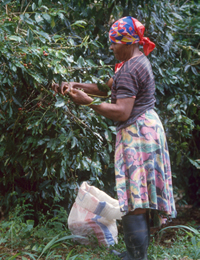
Several of my students have looked at the impact of human habitat conversion on birds by comparing their ecology in natural habitats (e.g., Caribbean dry forest, montane forest, mangroves) versus altered ones (e.g., citrus groves, shade coffee, suburban and rural residential areas). For example, our research shows that many migrants find shade coffee plantations to be an excellent winter habitat in terms of food abundance, bird abundance, suitability of the habitat throughout the dry season, and persistence throughout the winter. We have studied the available food resources for birds in shade coffee, coastal and montane Caribbean habitats, the similarity in diets among species, the potential for intra- and interspecific competition, and the consumption of coffee insect pest species by birds, among other topics. We are looking at the potential for interspecific food competition involving American redstarts throughout the annual cycle.
We recently completed a10-year study of the impacts of forest loss and fragmentation on resident tropical birds in the Caribbean lowlands of Costa Rica and nearby countries. This research resulted in several Ph.D. dissertations, dozens of publications, and a summary by Visco et al. (2015, Biological Conservation paper—see CV).
Research continues on the year-round ecology of the American redstart (Setophaga ruticilla), a Neotropical-Nearctic migrant. Diverse studies have been conducted in the Hubbard Brook Experimental Forest, NH, in Jamaica, and Louisiana. A goal of this effort is to integrate year-round ecology of this species as a model long-distance migrant. Some recent highlights of this research include experimental manipulation of food to overwintering redstarts in black mangroves that altered body condition and departure timing (Cooper et al., Ecology, 2015); and the discovery of far more floater individuals in Jamaican populations than previously suspected, with important implications for wintering ecology and population limitation (Peele et al., The Auk: Ornithological Advances, 2016). All Redstart research to date has been summarized by Sherry and collaborators in the updated (December, 2016) Birds of North America species account.
 Several
students have been looking at the ecology and conservation of
migrant species that are either endangered or threatened (e.g.,
swallow-tailed kite, Swainson's warbler). Some of this work is
conducted in fragmented versus unfragmented bottomland hardwoods
habitats of Louisiana.
Several
students have been looking at the ecology and conservation of
migrant species that are either endangered or threatened (e.g.,
swallow-tailed kite, Swainson's warbler). Some of this work is
conducted in fragmented versus unfragmented bottomland hardwoods
habitats of Louisiana.
Several studies have been conducted on colonial wading birds (e.g., herons, ibises, egrets) in Louisiana, including the impacts of crawfish aquaculture and heavy metal contamination on their populations.
My lab continues to look at prey selection and ecology of migrant and tropical birds, and birds in general. For example we have compared prey types and sizes eaten by redstarts in Jamaica, Louisiana (breeding and birds migrating through), and New Hampshire; and we have been comparing prey eaten versus available in wet limestone Jamaican habitats to look at how animals select food, how they have become specialized dietarily, and how they compete, using both ecological and evolutionary approaches. Some of this work is summarized by Sherry’s Chapter 8, Avian Food and Foraging, in the Cornell Laboratory of Ornithology’s Handbook of Bird Biology, 3rd Edition, 2016.
My interests have expanded recently to teaching and activism
surrounding climate change, which increasingly threatens all the
organisms and ecosystems I’ve studied throughout my career.
Back to Top
Teaching
General Ecology
Conservation Biology
“Climate Change across the Curriculum: Science, Stakes, and Solutions” (senior elective seminar within the Social Innovation and Social Entrepreneurship = SISE minor, in the Taylor Center for Social Innovation and Design Thinking)
Past courses taught: Population Biology, Ornithology, Processes of Evolution, Vertebrate Morphology
Back to Top
Return to EEB Home Page