|
Reflections on 2008 Hammond Camp, May 30-June 1, 2008 by Edith Pike-Biegunska If I were to describe this year’s Hammond camp in one phrase, I would quote Taniyama-sensei and say: “no motion.” Taniyama-sensei used this phrase to describe exploding into an attack from complete stillness, projecting nothing to an opponent until the moment of decisive action. Yet this phrase is also an apt theme for the entire camp. “No motion.” I felt the challenge of this idea in trying to execute Taniyama-sensei’s whipcord hip-snap in back stance, freezing legs and posture to isolate motion to just the hips. In fact, the challenge of doing this repeatedly nearly led to complete paralysis – truly no motion – as my stiff hips quivered reluctantly in sorry imitation of Taniyama-sensei. As we drilled the heian katas, both the beginning and end of each movement required complete stillness, no motion. Perhaps most importantly, Taniyama-sensei’s exercises forced me out of my comfort zone, clearing the noise in my head and forcing me to focus solely on how my body was moving. Indeed stilling the mind is often the greatest challenge in improving one’s karate. Since I first began training karate, many of the themes of this year’s camp have been regularly drilled into my mind and body, included elimination of excessive movement, explosive action, and strong hip rotation. Yet it is often easy to know the importance of these basics, but to overlook them in training. This year’s Hammond camp offered a chance to revisit these ideas by looking at them through a new perspective. By stilling my mind, and forcing my body to focus on challenging new movements, I rediscovered the importance of these fundamental karate principles. I must admit that my first reaction to Taniyama-sensei’s instruction on how to move, “no motion,” was to think: how can I move if I am not moving? Yet if one thinks of karate as selective motion, this makes perfect sense. Move only when you are ready. Avoid unnecessary, excessive movements. Clear your mind of intruding thoughts. This year’s Hammond camp was an exhilarating learning experience, and one that has led me to reassess my own karate and motivated me to train better and harder. It was truly an honor to have the opportunity to train with and learn from Taniyama-sensei.
TKC Shotocup Report (Sharon Davidson) April 25, 2007 Dear TKC Members, I am living in Philadelphia these days, missing our practices and your company, but continuing to train here and making new friends too. I am writing to share my experience and reflections as a TKC member getting the opportunity to go to the World JKA “Shotocup” tournament for the first time last year. I started karate with TKC in 1996 as a Sophomore at Tulane, impressed with the quality of the instructors and students I saw there. I hope you appreciate as I do that you are training in one of the best clubs in the country. I know that we will see each other from time to time as I visit NOLA or at tournaments, and I am looking forward to those times. Selection for US Team and TKC Reflections In April 2006, a group of karate students stood in a gymnasium in Boston, in the usual post-training fashion, standing in straight lines, attentive postures, eyes ahead, gis thoroughly sweaty. In actuality, in the crowd was a small group of students from across the country that were invited to and had just then finished an informal tournament. The tournament was used to select approximately 15 men and women to be the 2006 JKA/ISKF US National Team, which would be sent to Sydney, Australia in four months to compete in the JKA bi-annual world tournament, normally called the “Shotocup.” This event was renamed for JKA’s founder last year in honor of the tournament’s 10th anniversary, the “JKA Gichin Funakoshi 10th World Cup.” When the names of the US National Team members were called, and I could hardly believe I was one of them. I dreamed of such a moment back when I was a white belt at TKC, and suddenly it had come true. That moment was the culmination of ten years of diligent karate practice, lots of tournaments and lots of lessons learned. It was a quiet yet surreal moment of joy, reflecting on all the years of growing, and all the people who had helped me get there. Whatever happened in Sydney, just being selected for the team was the real trophy, the honor of being a representative for my country and for my teachers. When you train for several years with the same group of people, they become like family. I do think of Kyriakos as my “karate dad.” Whenever I got into sloppy or lazy moods, I could count on him to straighten me up. He knows me extremely well now, and I realized long ago that what sometimes seems like pushing and scolding is actually him showing faith in you and caring enough to help. We all have Kyriakos to thank for TKC. He is the heart and soul driving the club, pushing students to improve, but also creating a supportive environment where it is safe to learn. That is no small task. If it had not been for Kyriakos, I might never have discovered karate. I never forget that fact. When Devin and Dimitri’s names were called for US Team, I was hardly surprised. That was modus operandi for the dynamic duo. Devin and Dimitri were always those blurs in my peripheral vision at practice, indicators of what speed I should be moving, how the technique was supposed to look, and constant inspiration for me to train harder. Devin was actually my very first teacher at TKC, showing me Heian Shodan and how to make a proper fist. As amazingly talented and accomplished as both Devin and Dimitri are, you will never see inflated egos or useless flashy techniques from them. That’s because those attitudes are not consistent with karate’s purpose, and certainly not TKC’s style. Even though I look up to my senpai, I constantly learn a great deal from my kohai too. Good spirit from every karate student makes a great training. The large, spirited classes at TKC last summer were important to our preparation for Sydney. I never had anything but respect for and from my teachers and peers in Southern Region. On team selection day, I felt like a little karate sister who had finally grown up and could hang out with the big guys. It was my chance to make my karate family proud. Getting to go to Sydney wasn’t all that bad either! Preparing for and Traveling to Sydney Although I had relocated out of state after Hurricane Katrina, I came back to New Orleans in summer 2006 to live and train with my karate family. Like I said before, this was an honor to represent our teachers, and Devin, Dimitri and I acutely felt that responsibility. We dreamed of making them proud, but we also feared letting them down, so we really sweated it out that hot summer, trying to work through an overwhelming mix of excitement and anxiety. August rolled around too quickly and then Devin, Dimitri and I were headed for Sydney. We had trained all summer with Kyriakos and one other crucial person I have left out of the story until now, Sensei Mikami. It is difficult to describe the respect and affection we all have for Sensei Mikami. Of course Kyriakos, Devin and Dimitri had been with Sensei for many years before I even started karate. We never stop wondering at his incredible skill. We all have a sense of deep gratitude for the care he puts into each of us, deftly pushing our limits. There were many practices this summer and years before where it seemed like our gis were drenched, the air in the dojo getting hotter and thinner each second, and our exhausted limbs felt so impossibly heavy - and then hearing Sensei’s voice and tone – we knew we had to dig down deep inside and find a way to come through, to straighten up and do the techniques better. We know that none of our accomplishments compare to Sensei’s, and we only hope to follow his example of strength in mind and body. So there we were on August 14th, Devin, Dimitri and I boarding our third plane for the last leg of our journey from San Francisco to Sydney, with Sensei Mikami, our karate idol. At the risk of sounding a little dorky, getting to spend a little time with Sensei Mikami was clearly a trip highlight for all three of us. The 13 hour plane ride – not so much. We got up and stretched every few hours, not only trying to alleviate the crazy swollen ankles and fingers we were getting from the high altitude, but also because stiff muscles could turn into injuries over the next couple of days, which could ruin us at tournament. On this particular plane we met up with most of the other US Team Members from all over the country, familiar faces that we had come to know from going to nationals and camps through the years. Looking at my teammates prompted the reflection that in my early years of competition, these were the people I had viewed as “bitter rivals.” Back then it was probably fair to say that I was overly competitive, and I only cared about TKC winning medals. At tournaments I wanted to intimidate and destroy our club rivals. With each successive level of competition that I ascended, however, I realized that I couldn’t turn rivals into allies overnight, and I inevitably needed strong competitors on my side whenever a team was formed. So while I continued to compete hard in the ring, outside the ring I started supporting my competitors more. I realized that if we all improved now, we made a stronger team later. Looking around the plane to Sydney, I saw karateka who also understood this and had earned each other’s respect. From what Dimitri and Devin told me, we had a particularly close-knit group this year. We didn’t just help each other at the tournament, exchanging advice and encouragement, we also built up our friendships throughout the entire trip. US Team Training in Sydney Once we arrived in Sydney, we had about two days before Eliminations. On the first day we all planned how to overcome the monstrous jet lag and we all went to the tournament facility to try out the floors. We were careful to stretch and warm up slowly after the long plane ride (no hernias, please). We had one team training each day, and instead of lining up we often formed a circle and faced the center. The circle was helpful to be able to see each other and it gave us a strong team spirit. Even on the morning of Finals, when only a few of us would actually compete that day, the entire team dressed out and warmed up in a circle. This helped to normalize the day for our finalist teammates and reinforced the idea that the goal here was not to win or lose but to do our best and to support each other. Despite all the hubbub and things we wanted to see in Sydney, we all were careful to set aside time to eat well, and also to rest and relax our bodies. The Tournament, August 19th - 20th, 2006 During Eliminations I received some great advice from one of our team coaches, Sensei Takahasi, who told me, “Don’t worry about winning. Just show good spirit!” That timely advice enabled me to relax and fight well I believe. It was the perfect thing to say to me and I appreciated his skill in not adding pressure to an already overwhelming experience. I won my first fight, which was in team kumite against the French team. We beat them 2 to 1, and then went on to fight Australia, where we got beaten 3 to 0. In the individuals I lost to an excellent competitor, a tall Japanese girl who ultimately went on to win the gold in women’s individual kumite. Although I lost, I am proud of the fact that I “showed good spirit” when I fought her. The Japanese team has a strong history of dominating at Shotocup, and many people were clearly intimidated whenever facing a Japanese competitor. I did not want to make that mistake at least. This year’s Japanese women’s kumite team did one particular combination frequently, and they did it extremely well. They exploded forward and did two punches, and then instead of reversing their movement to regain a safe distance from their opponent, they just continued forward and passed closely by the side of their opponent’s body. This made it difficult for an opponent to counter because the distance was cramped. The two punches were either to face then stomach or to high chest then stomach. When I stepped into the ring, I just told myself that I had to be ready for that particular technique. I didn’t think about getting a point as much as just trying to hit her squarely and hard enough so that she would not want to “explode in” afterwards. She did indeed start keeping her distance after our first collision, and I thought I fought well even though I lost. It seems I always learn the most from my losses and regrets anyhow, so I have a lot to stew on now! After we each finished our events, the team members tried to watch and support anyone still going, but we missed a lot since several events went simultaneously among the six rings. We did not give too much advice, at most giving each other one concise tip. Otherwise we just tried to encourage each other. In an odd coincidence, Devin managed to get the same person in both the team and the individual kumite events, an impressive fighter from Argentina. Argentina’s kumite team ultimately made it to Finals, in fact. In their first match they tied. The second match was incredibly close, coming down to a half point that Devin’s opponent scored in the last few seconds. If he had not, a second later a new overtime match would have started. It seemed to me that Devin’s opponent was also very good at covering distance, so they both made it difficult to reach each other. It was just a painfully close match. Not surprisingly, this opponent of Devin (Justo Gomez) a couple of months later became the world’s kumite champion for ITKF in Canada. Dimitri got some good fighters also, and did very well, making it to the final eight for individual kumite. At the end of Eliminations, we had one man and one woman going to individual kumite Finals, and both of the kata teams made the Finals too. We were all proud to have such a healthy representation of US Team members in Finals, showing that our country definitely has the ability to be strong contenders at that level of competition. Finals were really fun to watch. We saw great talent from many countries. I don’t think anyone will soon forget the women’s kata team from Egypt, with such unique and almost surreal synchonicity. Dimitri’s last fight in the Finals was incredibly intense, against a young Japanese competitor. The rest of the US Team watched from the stands and we were all literally on the edge of our seats. The match was like a game of concentration, with Dimitri and his opponent just moving around the ring and watching each other intently for periods lasting over a minute at a time. Both Dimitri and his opponent were clearly very wary of each other. This continued through at least one round of overtime. This is much like the dynamic you often see at TKC when Devin and Dimitri fight, where two experienced fighters will refrain from flying in and throwing just anything, knowing that their opponent will exploit any hole in the attack, so instead they read each other carefully, watching and waiting for a good opportunity, any moment of inattention or imbalance or a chance to break the opponent’s rhythm. I know that Dimitri was frustrated that he did not go further, but we were all immensely proud of his performance. Seeing Sydney We did find time here and there to see some sights and experience a little of Aussie life. One memorable place we visited was a restaurant called “Phillip’s Foot,” which was not far from the Sydney Opera House landmark. At Phillip’s Foot we chose lovely cuts of meat and then cooked them ourselves on one of the three large grills in the dining area. Apparently cold spaghetti is Aussie standard fare, oddly enough. We saw that at the Phillip’s Foot and a couple of other places. The restaurant had large wooden tables outside with lovely green trees serving as a canopy. The whole US Team went together and we had a great time. We had a mild food fight, throwing bits of bread at anyone who was spacing out (yes, that definitely included me) then blaming it on “the squirrels.” It was a lot of laughs with a great group of people. We definitely tried out some Aussie beers too, especially after Finals. Devin showed us his skill in counting out Aussie coins despite being thoroughly inebriated. At that moment a few of us were finding that math unusually challenging. Of course the purpose of that task was to consolidate our coins… so that we could all buy more beers of course. Some of the girls went on a shopping excursion. Dimitri and Devin were less enthused about the shopping activity, if you can imagine that. We came back with a ridiculous amount of opals, boomerangs and kangaroo everything. Did you know that they make pouches out of real kangaroo scrotums? They are supposed to be lucky. The kangaroos themselves, however, are clearly not so lucky. See You Soon Hopefully it will not be too long before I see the Big Easy and TKC again. Since I have a captive audience I will abuse you by offering a few nuggets of knowledge, things that I think helped me grow at TKC: (1) train regularly, even when you are tired or have little colds, (2) listen carefully and remember what you have been corrected on, and (3) be honest in your reflections and humble in your accomplishments, because they are simultaneously a function of your teachers’ contributions, and your awesome TKC. And when you go to tournaments, don’t ever let yourself be intimidated. You do truly train in one of the best dojos there is. Take care and keep kicking butt! Yours, (sharonvdavidson@hotmail.com)
|
Edith's report on the Shotocup 2004
I have had many excellent opportunities to study karate since coming to Japan with the JET Program in 2003. Besides training regularly at a local dojo, I have visited the Hombu-dojo in Tokyo and participated in several competitions, including the all-Japan. I have also learned and grown more enthusiastic about karate by watching others compete. Most recently, I had the chance to watch the 2004 Shoto Cup World Championship in Tokyo on September 22-23.
This was my first Shoto Cup, and initially I was surprised with the compactness of the Nippon Budokan where it was held. The hallways, wrapping tightly around the hexagonal arena, were packed with souvenir stands, competitors, judges, and spectators. Inside the stadium, the four mats laid out for the semifinals crowded onto a floor roughly one-third the size of the area of the all-Japan tournament. I soon came to appreciate the layout, however, since it brought me closer to the rings and to the charged atmosphere of the competition. I settled into my seat, delighted that I could watch the events unfold directly below me.
234 athletes from 34 countries entered in the semifinals, offering a chance to witness the wide range of skill and styles in JKA karate throughout the world. The successful contestants in both kata and kumite were those with the most traditional, straight-forward moves. Kata steps avoided unnecessary flourishes, and kumite depended on timing and decision, not elaborate techniques.
The U.S. team competed strongly and qualified for the finals in three events. I was excited to have a chance to see two competitors from the Southern region, Dimitri Papadopoulos and Joe Giluso, fight for the U.S. in both team and individual kumite. The men’s kumite team sparred well, defeating France in its first round but losing to Japan in the next. Both the women’s kata and kumite teams went on to the finals. Dimitri was the only member of the U.S. team to qualify for the finals in an individual event. Unfortunately, an injury from his last fight prevented him from participating the next day.
The second day of the competition, the Japanese reclaimed their first-place titles from the previous Shoto Cup in every event. They did not, however, prevail easily. Several rival performances impressed me that day. South Africa’s men’s and women’s kumite teams both fought solidly, placing the women in second place and the men in third. In men’s team kumite, Argenitna beat Venezuela in a heated match and moved up to fight Japan for first place. An interesting combination of strategies decided the results of individual women’s kumite. A very tall Yugoslavian woman demonstrated the benefit of height as she outreached her competitors into third place. She shared the podium with a shorter, but much more explosive Hungarian. The fight which most impressed me was a very close match between the Swede, Miroslaw Femic and Ogata Koji of Japan in individual men’s kumite. The two each scored a clean wazari, and left the outcome for first and second place uncertain to the end.
Several teams and individuals performed impressive katas as well, leaving the results of the more subjective half of the competition less clear. While Japan swept up every medal in individual kata for both men and women, the other competitors demonstrated that they could rival Japan’s skill in kata during the team events. Germany’s women’s team and Myanmar’s men’s team both challenged Japan’s domination with their powerful, perfectly synchronized, impeccable routines.
If I were to choose one recurring theme from among all the events I saw at the Shoto Cup, I would pick the value of simplicity. The same basic rules about clearing the shortest distance, reaching when attacking, and avoiding unnecessary movement repeated in class from white belt on proved their worth in competition. More points were scored in kumite with a commited, precise reverse punch or step-in punch than with any other step or combination. Kata movements followed the same rule, and were direct and powerful. After technique and strategy, the rest the competitors’ success lie in their strength of will. Indeed, their spirit was the most inspiring feature of all at the tournament.
Edith's report on the All-Japan 2004
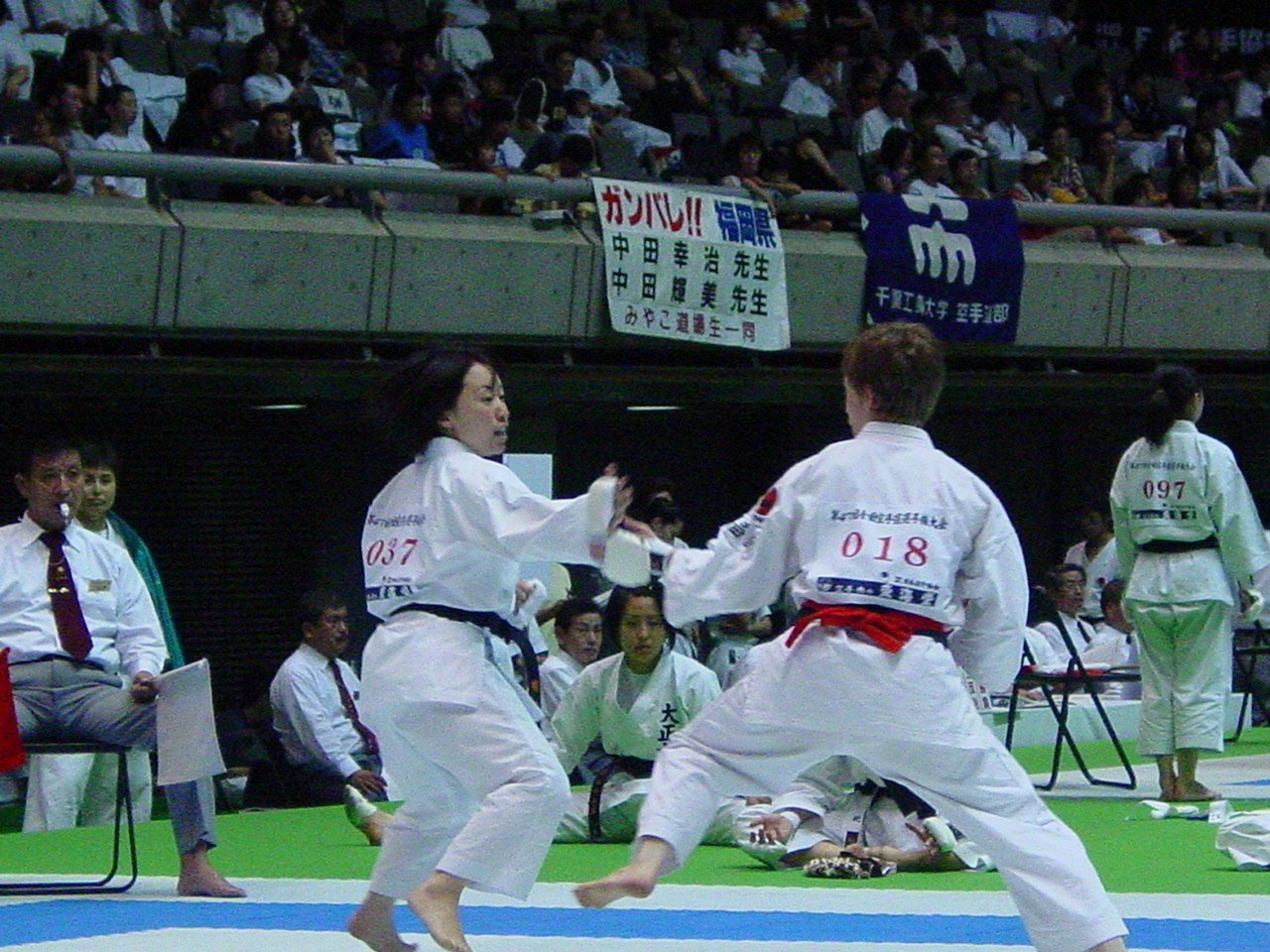
On July 10-11 I attended the all-Japan karate tournament in Tokyo. The first day high school students and adult teams competed in kata and kumite. Individual adults entered the next day, following the official opening ceremony. There were many competitors: 69 women and 115 men in kata, and 67 women and 124 men in kumite.
I enjoyed watching the events the first day. The collective spirit and consistent strength of the high school teams was truly impressive. From the stands I had a bird’s eye view of the six mats below, and a chance to see not only the kata and kumite, but also the interaction among and between teams. There were no weak competitors, which hardly surprised me. High-school students’ tattered white belts attest to their rigorous training schedules. They generally train three to four hours a day, six days a week. Whether in competition or while cheering for their teammates, the students all showed unwavering spirit throughout the tournament, Most everyone performed kata in impressively low stances and with very accurate movements. Those who progressed to the finals also demonstrated speed and very focused power. Fast footwork and punches characterized girl’s kumite. Boy’s kumite was very strong and aggressive, and would have been even more remarkable if not for the abundant injuries.
The next day, I competed. Adult events began with women’s kata, immediately after the opening ceremony. As we lined up to bow before the first round I felt very self-conscious. I was the only foreigner in sight, standing on an elevated platform with senseis from every region of Japan watching. I was completely alone until the top competitor from our local high school team ran up to cheer me on. The head sensei from the high school also came over to offer some last minute advice. They both encouraged me throughout my kata and kumite, and made sure I knew where to go. The student stuck to me the entire time, and insisted on carrying my water bottle and gloves for me. I was very touched by her support.
There were five rounds of women’s kata, starting with the Heians. In the second round the judge drew a card from among Jion, Bassai Dai, Empi, and Kandu Dai. I was eliminated after completing Bassai Dai in the third round. The women’s kata was impeccably precise, with low stances and a stark contrast between slow and fast movements. The competitors who went on to place in the finals had, in addition, razor-sharp kime. The same trend applied to men’s kata. Unsu, Gojushiho Sho, and Hangetsu were the most popular kata for both men and women. The winner of men’s kata performed Jitte.
Kumite was much more controlled the second day. Punches still dominated both women’s and men’s fights. The men threw some kicks, but punches scored most points. I won one fight, and lost my second. After that I watched some impressive and intimidating matches. The judges were very strict, though, and there were far fewer injuries than the day before. In the women’s finals I was struck by the finalists’ reach. They would start their attacks from a distance and then fly at each other with powerful, direct punches. The men were more pensive, and fought closer together. They were very accurate and straightforward with their moves.
The all-Japan was very fun and truly inspiring. From the size of the gym to the number of participants and quality of the judges, the tournament promised no less than it delivered. It was a remarkable experience.