| EENS 204 | Natural Disasters |
| Tulane University | Prof. Stephen A. Nelson |
Mass-Wasting and Mass-Wasting Processes |
|
Mass-Wasting and its Human Impacts Mass-Wasting is defined as the down slope movement of rock and regolith near the Earth's surface mainly due to the force of gravity. Mass-wasting is an important part of the erosional process, as it moves material from higher elevations to lower elevations where transporting agents like streams and glaciers can then pick up the material and move it to even lower elevations. Mass-wasting processes are occurring continuously on all slopes; some act very slowly, others occur very suddenly, often with disastrous results. Any perceptible down slope movement of rock or regolith is often referred to in general terms as a landslide. Landslides, however, can be classified in a much more detailed way that reflects the mechanisms responsible for the movement and the velocity at which the movement occurs. As human populations expand and occupy more and more of the land surface, mass-wasting processes become more likely to affect humans. The table below shows the impact of mass-wasting processes on human life over the last century. |
| Year | Location | Type | Fatalities |
| 1916 | Italy, Austria | Landslide | 10,000 |
| 1920 | China | Earthquake triggered landslide | 200,000 |
| 1945 | Japan | Flood triggered landslide | 1,200 |
| 1949 | USSR | Earthquake triggered landslide | 12,000-20,000 |
| 1954 | Austria | Landslide | 200 |
| 1962 | Peru | Landslide | 4,000-5,000 |
| 1963 | Italy | Landslide | 2,000 |
| 1970 | Peru | Earthquake related debris avalanche | 70,000 |
| 1985 | Columbia | Mudflow related to volcanic eruption | 23,000 |
| 1987 | Ecuador | Earthquake related landslide | 1,000 |
| 1998 | Nicaragua | Debris avalanche and mudflow tirggered by heavy rains during Hurricane Mitch | ~2,000 |
| 2001 | El Salvador | Earthquake-induced landslide | 585 |
| 2006 | Philippines | Rain triggered debris avalanche | >1100 |
In a typical year in the United States, landslides cause over $2 billion in damages and 25 to 50 deaths. In other countries, especially less developed countries, the loss is usually higher because of higher population densities, lack of zoning laws, lack of information about mass-wasting hazards, and lack of emergency preparedness. Between 1969 and 1993, worldwide, landslides caused an average of about 1550 deaths per year. Knowledge about the relationships between local geology and mass-wasting processes can lead to better planning that can reduce vulnerability to such hazards. Thus, we will look at the various types of mass-wasting processes, their underlying causes, factors that affect slope stability, and what humans can do to reduce vulnerability and risk due to mass-wasting hazards.
|
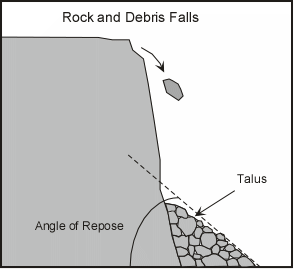
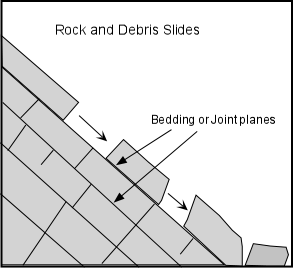
Types of Mass-Wasting Processes The down-slope movement of material, whether it be bedrock, regolith, or a mixture of these, is commonly referred to as a landslide. All of these processes generally grade into one another, so classification of such processes is somewhat difficult. We will use a classification that divides mass-wasting processes into two broad categories (note that this classification is somewhat different than that used by your textbook).
|
| Slope Failures | |
|
![]() |
|
![]() |
|
![]() |
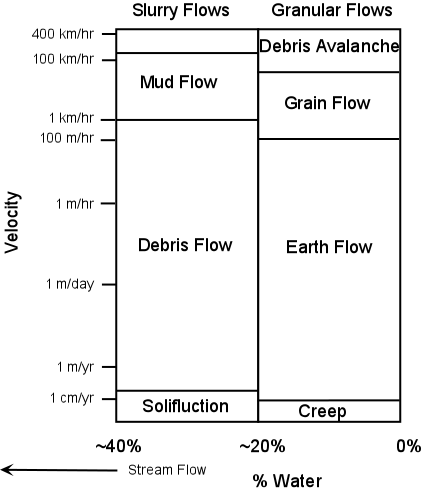
Sediment Flows Sediment flows occur when sufficient force is applied to rocks and regolith that they begin to flow down slope. A sediment flow is a mixture of rock, and/or regolith with some water or air. They can be broken into two types depending on the amount of water present.
|
![]() |
| Each of these classes of sediment flows can be further subdivided on the basis of the velocity at which flowage occurs. |
Mudflows |
|
| Mass-Wasting in Cold Climates Mass-wasting in cold climates is governed by the fact that water is frozen as ice during long periods of the year. Ice, although it is solid, does have the ability to flow, and freezing and thawing cycles can also contribute to movement.
Subaqueous Mass-Wasting Mass wasting processes also occur on steep slopes in the ocean basins. A slope failure can occur due to over-accumulation of sediment on slope or in a submarine canyon, or could occur as a result of a shock like an earthquake. Slumps, debris flows, and landslides are common. |