| EENS 204 | Natural Disasters |
| Tulane University | Prof. Stephen A. Nelson |
The Ocean-Atmosphere System |
|
The Ocean-Atmosphere System The oceans and the atmosphere are the two large reservoirs of water in the Earth's hydrologic cycle. The two systems are complexly linked to one another and are responsible for Earth's weather and climate. The oceans help to regulate temperature in the lower part of the atmosphere. The atmosphere is in large part responsible for the circulation of ocean water through waves and currents. In this section we first look at how the atmosphere controls weather and climate, and we will explore some the introductory material necessary to understand our upcoming lectures on severe weather. Weather and Climate Weather is the condition of the atmosphere at a particular time and place. It refers to such conditions of the local atmosphere as temperature, atmospheric pressure, humidity (the amount of water contained in the atmosphere), precipitation (rain, snow, sleet, & hail), and wind velocity. Because the amount of heat in the atmosphere varies with location above the Earth's surface, and because differing amounts of heat in different parts of the atmosphere control atmospheric circulation, the atmosphere is in constant motion. Thus, weather is continually changing in a complex and dynamic manner. Climate refers to the average weather characteristics of a given region. Climate, although it does change over longer periods of geologic time, is more stable over short periods of time like years and centuries. The fact that the Earth has undergone fluctuation between ice ages and warmer periods in the recent past (the last ice age ended about 10,000 years ago) is testament to the fact that climate throughout the world as has been changing through time. The Earth's weather and climate system represent complex interactions between the oceans, the land, the sun, and the atmosphere. That these interactions are complex is evidence by the difficulty meteorologists have in predicting weather on a daily basis. Understanding climate change is even more difficult because humans have not been around long enough to record data on the long term effects of these processes. Still, we do know that the main energy source for changing weather patterns and climate is solar energy from the Sun. |
The Atmosphere Earth's atmosphere consists of a mixture of Nitrogen (N2) and Oxygen (O2). At the Earth's surface, dry air is composed of about 79% Nitrogen, 20% Oxygen, and 1% Argon. It can also contain up to 4% water vapor at saturation, but saturation depends on temperature.
|
| Relative humidity is the term used to describe saturation with water
vapor. When the relative humidity is 100%, the atmosphere is saturated with respect to
water vapor, and precipitation results. Other gases occur in the atmosphere in small
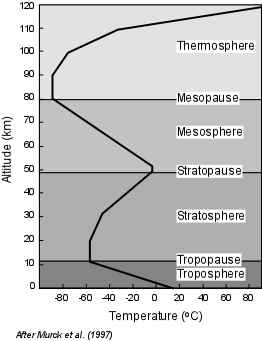
amounts. Among the most important of these other gases is Carbon Dioxide (CO2). The atmosphere has a layered structure, as shown here. Each layer is defined on the basis of properties such as pressure, temperature, and chemical composition. The layer closest to the surface is called the troposphere, which extends to an altitude of 10 to 15 km. Temperature decreases upward in the troposphere to the tropopause (the boundary between the troposphere and the next layer up, the stratosphere). The troposphere contains about 90% of the mass of the atmosphere, including nearly all of the water vapor. Weather is controlled mostly in the troposphere. |
![]() |
|
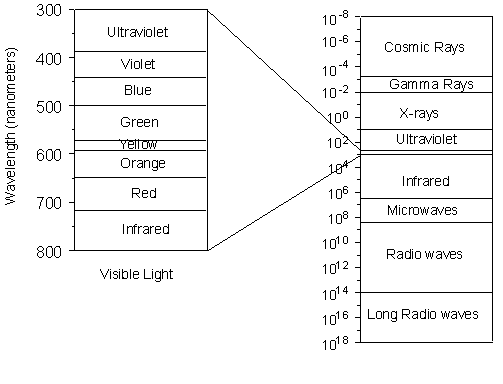
Solar Radiation and the Atmosphere Radiation reaching the Earth from the Sun is electromagnetic radiation. Electromagnetic radiation can be divided into different regions depending on wavelength. Note that visible light is the part of the electromagnetic spectrum to which human eyes are sensitive. |
![]() |
|
Greenhouse Gases
|
![]() |
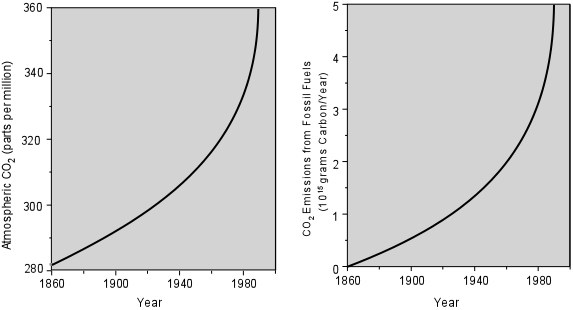
| Methane concentration in the atmosphere has also been increasing. Naturally this occurs due to decay of organic matter, the digestive processes of organisms, and leaks from petroleum reservoirs. Humans have contributed through domestication of animals, increased production of rice, and leaks from gas pipelines and gasoline. |
| Volcanic Effects Volcanoes produce several things that result in changing atmosphere and atmospheric temperatures.
The Mt. Pinatubo eruption in 1991 and El Chichķn eruption in 1981 released large quantities of dust and sulfur gases - resulted in short term cooling of atmosphere. Volcanism in the middle Cretaceous produced large quantities of basalt on the seafloor and released large amounts of CO2. The middle Cretaceous was much warmer than present, resulting in much higher sea level. |
|
The Carbon Cycle In order to understand whether or not humans are having an effect on atmospheric carbon concentrations, we must look at how carbon moves through the environment. Carbon is stored in four main reservoirs.
|
| Cycling between the atmosphere and the biosphere occurs
about every 4.5 years. Cycling between the other reservoirs probably occurs on an average
of millions of years. For example, carbon stored in the lithosphere in sedimentary rocks or as fossil fuels only re-enters the atmosphere naturally when weathering and erosion expose these materials to the Earth's surface. When humans extract and burn fossil fuels the process occurs much more rapidly than it would occur by natural processes. With an increased rate of cycling between the lithosphere and the atmosphere, extraction from the atmosphere by increased interaction with the oceans, or by increased extraction by organisms must occur to balance the input. If this does not occur, it may result in global warming. |
|
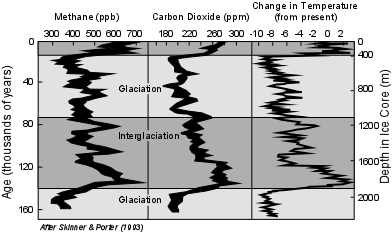
Global Warming Average global temperatures vary with time as a result of many processes interacting with each other. These interactions and the resulting variation in temperature can occur on a variety of time scales ranging from yearly cycles to those with times measured in millions of years. Such variation in global temperatures is difficult to understand because of the complexity of the interactions and because accurate records of global temperature do not go back more than 100 years. But, even if we look at the record for the past 100 years, we see that overall, there is an increase in average global temperatures, with minor setbacks that may have been controlled by random events such as volcanic eruptions. Records for the past 100 years indicate that average global temperatures have increased by about 0.7oC. While this may not seem like much, the difference in global temperature between the coldest period of the last glaciation and the present was only about 7oC. |
| Effects of Global Warming Among the effects of global warming are:
|
|
Climate Change Because human history is so short compared to the time scales on which global climate change occurs, we do not completely understand the causes. However, we can suggest a few reasons why climates fluctuate.
|
|
|
|
|
Circulation in the Atmosphere |
|
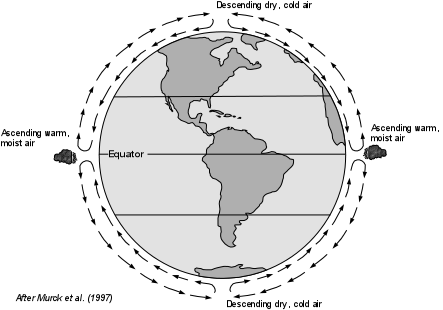
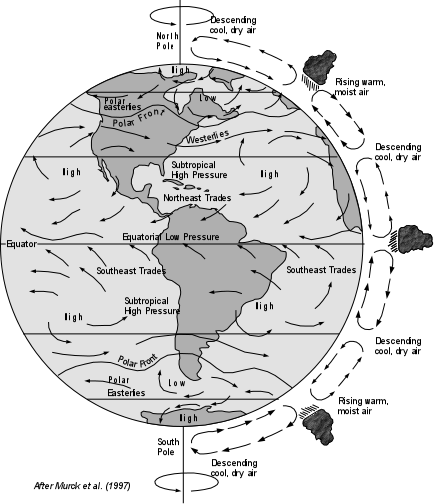
| The troposphere undergoes circulation because of convection. Recall that convection is a mode of heat transfer. Convection in the atmosphere is mainly the result of the fact that more of the Sun's heat energy is received by parts of the Earth near the Equator than at the poles. Thus air at the equator is heated reducing its the density. Lower density causes the air to rise. At the top of the troposphere this air spreads toward the poles. |
![]() |
| If the Earth were not rotating, this would result in a convection cell, with warm
moist air rising at the equator, spreading toward the poles along the top of the
troposphere, cooling as it moves poleward, then descending at the poles, as shown in the
diagram above. Once back at the surface of the Earth, the dry cold air would circulate back
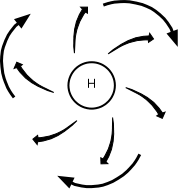
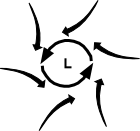
toward the equator to become warmed once again. Areas where warm air rises and cools are centers of low atmospheric pressure. In areas where cold air descends back to the surface, pressure is higher and these are centers of high atmospheric pressure.
|
|
![]() |
| Wind Systems | |
|
![]() |
|
![]() |
|
![]() |
|
|
|
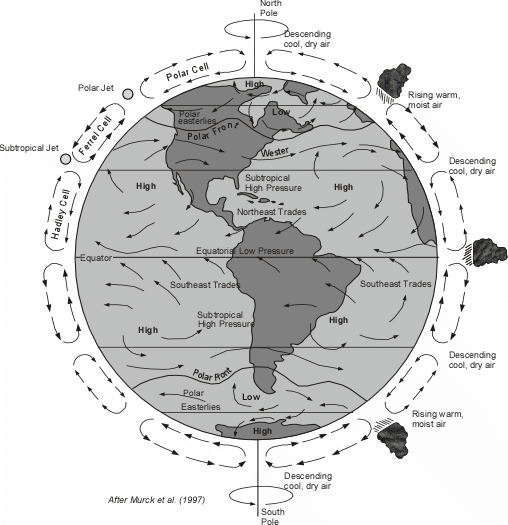
The convection cells circulating upward from the equator and then back to surface at the mid-latitudes are called Hadley cells. Circulation upward at high latitudes with descending air at the poles are called Polar cells. In between are cells referred to as Ferrel cells. At high altitudes in the atmosphere narrow bands of high velocity winds flowing from west to east are called the jet streams. The polar jet occurs above the rising air between the Polar cells and the Ferrel cells. The subtropical jet occurs above the descending air between the Ferrel cells and the Hadley cells. These jet streams meander above the earth's surface in narrow belts. In the northern hemisphere, where the jet streams meanders to the south it brings low pressure centers (and associated storms) further to the south. Where it meanders to the north, the high pressure centers move to the north. See figure 11-14 on page 289 of your text. |
|
|
Atmospheric circulation is further complicated by the distribution of land and water masses on the surface of the Earth and the topography of the land. If the Earth had no oceans and a flat land surface, the major climatic zones would all run in belts parallel to the equator. But, since the oceans are the source of moisture and the elevation of the land surface helps control where moist air will rise, climatic zones depend not only on latitude, but also on the distribution and elevation of land masses. In general, however, most of the world's desert areas occur along the mid-latitudes where dry air descends along the mid-latitude high pressure zones.
|
|
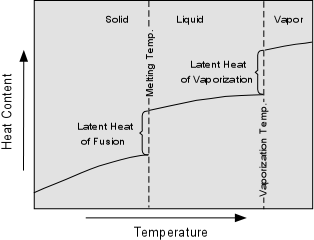
Water has one of the highest heat capacities of all known substances. This means that it takes a lot of heat to raise the temperature of water by just one degree. Water thus absorbs a tremendous amount of heat from solar radiation, and furthermore, because solar radiation can penetrate water easily, large amounts of solar energy are stored in the world's oceans. |
| Further energy is absorbed by water vapor as the latent heat of
vaporization, which is the heat required to evaporate water or change it from a liquid to
a vapor. This latent heat of vaporization is given up to the atmosphere when water
condenses to form liquid water as rain. If the rain changes to a solid in the form
of snow or ice, it also releases a quantity of heat known as the latent heat of
fusion. Thus, both liquid water and water vapor are important in absorbing heat from solar radiation and transporting and redistributing this heat around the planet.
|
![]() |
| As we will see throughout the next part of the course, this heat
provides the energy to drive the convection system in the atmosphere and
thus drives the water cycle and is responsible for such hazards as floods,
thunderstorms, tornadoes, and tropical cyclones.
|
|
Air Masses |
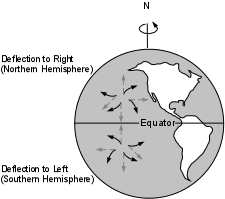
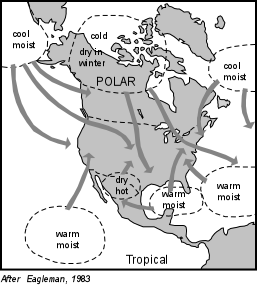
Due to general atmospheric circulation patterns, air masses containing differing amounts of heat and moisture move into and across North America. Polar air masses, containing little moisture and low temperatures move downward from the poles. Air masses that form over water are generally moist, and those that form over the tropical oceans are both moist and warm. Because of the Coriolis effect due to the Earth's rotation, air masses generally move across North America from west to east. But, because of the differences in moisture and heat, the collision of these air masses can cause instability in the atmosphere. |
![]() |
Fronts and Mid-latitude Cyclones |
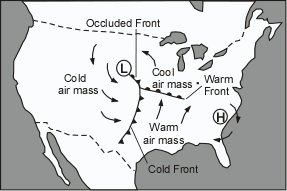
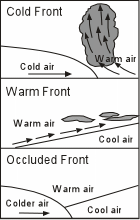
| When cold air moving down from the poles encounters warm moist air moving up from the Gulf of Mexico, Pacific Ocean, or Atlantic Ocean, a cold front develops and the warm moist air rises above the cold front. This rising moist air cools as it rises causing the condensation of water vapor to form rain or snow. Note that the cold air masses tend to circulate around a low pressure center in a counterclockwise fashion in the northern hemisphere. Such circulation around a low pressure center is called a mid-latitude cyclone. |
![]() |
| When warm air moving northward meets the cooler air to the north, a warm front forms. As the warm air rises along a gently inclined warm front, clouds tend to form, and can also cause rain, but rain is less likely because the warm front is not as steep as a cold front. If the rapidly moving cold front overtakes the warm front, an occluded front forms, trapping warm air above a layer of cold and cool air. Mid-latitude cyclones and their associated fronts are responsible for such severe weather conditions as thunderstorms, snow storms and associated hail, lightening, and occasional tornadoes. | ![]() |
El Niņo
The phenomena is manifested by the arrival of warm water off the coast of Peru around Christmas time, and thus is called El Niņo (Spanish for the boy child) because it arrives at this time. An El Niņo event occurs every 2 to 7 years with various degrees of strength. Some El Niņo events are more intense than others, and the condition lasts from 18 to 24 months. The following table lists the years of El Niņo events. |
El Niņo Years 1902-1903 1905-1906 1911-1912 1914-1915 1918-1919 1923-1924 1925-1926 1930-1931 1932-1933 1939-1940 1941-1942 1951-1952 1953-1954 1957-1958 1965-1966 1969-1970 1972-1973 1976-1977 1982-1983 1986-1987 1991-1992 1994-1995 1997-1998 2002-2003 2006-2007
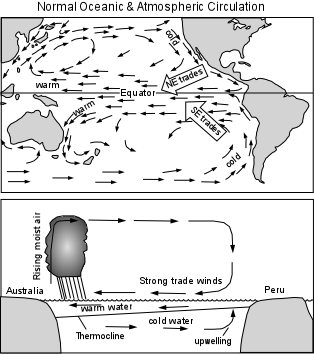
| "Normal" Conditions - Under "normal" conditions the easterly trade winds, driven by the pressure difference between the eastern Pacific high and the western Pacific low and blowing toward the equator, push warm water toward the equator and across the Pacific Ocean toward Australia and Indonesia. This causes a pool of warm water to form near the equator in the western Pacific. It also causes the thermocline (the boundary between warm waters in the upper layers of the ocean and the cold deep waters below) to move closer to the surface off the coast of South America, bringing nutrient-rich waters to surface by upwelling. Such nutrient-rich waters help sustain large fish populations. The upwelling cold water cools the atmosphere above, and prevents rain clouds from forming off the coast of Peru. |
![]() |
| The warm water pushed to the west by the trade winds, heats as it flows along the equator, so that on arrival in the western Pacific heat is added to the overlying atmosphere causing it to rise, form clouds, and produce extensive rainfall. The moisture depleted upper atmosphere then circulates back to east where it descends off the coast of South America contributing to the dry conditions. During periods of exceptionally strong trade winds the upwelling of cold water off the South America cools the water even further creating a condition called La Niņa (girl child). |
|
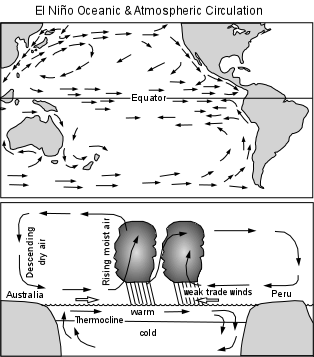
| El Niņo Conditions - During El Niņo periods there is a
weakening of the easterly trade winds and the warm waters of the western Pacific are
pushed toward the east. This causes the thermocline in the eastern Pacific to sink,
preventing the upwelling of cold waters from below, depleting the waters in nutrients, and
thus leading to starvation of fish populations. As the warm water shifts eastward so
does the development of atmospheric disturbances that lead to upwelling of the atmosphere
to form thunderstorms. Rising bodies of moist air thus occur closer to the coast of
the Americas, leading to increased storminess, not only in South America, but in North
America as well. These low pressure systems that develop in the eastern Pacific can
move over the continent and cause severe weather as noted above. |
![]() |
| In addition, they create upper level winds that tend to shear the tops off of
developing tropical storms and hurricanes in the Atlantic Ocean and Gulf of Mexico,
leading to a decrease in the number of intense tropical cyclones that develop in these
regions. La Niņa conditions have about the opposite effect of El Niņo conditions. i.e. better fishing harvests off the west coast of South America, drier conditions in North and South America, more hurricanes in the Atlantic, and wetter conditions in Australia and Indonesia. Over the past 50 years, the oscillation of warm water back and forth across the tropical Pacific Ocean has created El Niņo conditions 31% of the time, La Niņa conditions 23% of the time, and "normal" conditions 46% of the time. |
| Prediction of El Niņo As can be seen from the data presented above, the southern oscillation which creates the El Niņo condition has operated throughout the last century. Archeological evidence from South America indicates that the oscillation has been operating for thousands of years. Still, it has only been in recent years that atmospheric and ocean scientists have become aware of the phenomenon, and then only because particularly strong El Niņos occurred in the years 1982-83 and 1997-98 causing considerable damage from natural disasters in North America. The frequency of El Niņo events and the intensity of the events is not statistically predictable. In other words we do not as yet know when the next El Niņo will occur. This is due to the relatively short amount of historical data currently available. Still, the 1997-98 event and its intensity were predictable several months beforehand because measurements of sea surface temperature from satellites and instrument buoys in the Pacific Ocean were able to identify the movement warm surface waters from west to east across the Pacific Ocean. Thus, future El Niņo events will likely be predictable several months before they actually develop. This could have important economic consequences. For example, knowing that an El Niņo event is coming could result in farmers in normally dry parts of South America preparing the soil for a good crop months in advance because of the expected wetter weather in the months ahead. Fishermen could begin preparing for a poor fishing harvest off the coast of South America. In terms of Natural disasters, Peru was much better prepared for the 1997-98 El Niņo and constructed storm drains and stockpiled emergency supplies, probably saving thousands of lives. It is important to remember that because the southern oscillation shifts back and forth, some areas receive beneficial aspects of the phenomenon while other areas receive adverse aspects. For example, even though the 1997-98 El Niņo produced many natural disasters in North and South America, the northern part of the U.S. was somewhat warmer during the winter months resulting in the estimated savings of $5 billion in heating costs. |