EENS 204

Natural Disasters

Tulane University

Prof. Stephen A. Nelson

Volcanoes, Magma, and Volcanic Eruptions


Since volcanic eruptions are caused by magma (a mixture of liquid rock, crystals, and dissolved gas) expelled onto the Earth's surface, we must first discuss the characteristics of magma and how magmas form in the Earth.

Characteristics of Magma

Types of Magma

Types of magma are determined by chemical composition of the magma. Three general types are recognized:

  1. Basaltic magma --  SiO2 45-55 wt%, high in Fe, Mg, Ca, low in K, Na
  2. Andesitic magma --  SiO2 55-65 wt%, intermediate. in Fe, Mg, Ca, Na, K
  3. Rhyolitic magma --  SiO2 65-75%, low in Fe, Mg, Ca, high in K, Na

Gases in Magmas

At depth in the Earth nearly all magmas contain gas dissolved in the liquid, but the gas forms a separate vapor phase when pressure is decreased as magma rises toward the surface of the Earth.   This is similar to carbonated beverages which are bottled at high pressure. The high pressure keeps the gas in solution in the liquid, but when pressure is decreased, like when you open the can or bottle, the gas comes out of solution and forms a separate gas phase that you see as bubbles.   Gas gives magmas their explosive character, because volume of gas expands as pressure is reduced.  The composition of the gases in magma are:  

  • Mostly H2O (water vapor) & some CO2 (carbon dioxide)
  • Minor amounts of Sulfur, Chlorine, and Fluorine gases

The amount of gas in a magma is also related to the chemical composition of the magma.   Rhyolitic  magmas usually have higher gas contents than basaltic  magmas.


Temperature of Magmas


Temperature of magmas is difficult to measure (due to the danger involved), but laboratory measurement and limited field observation indicate that the eruption temperature of various magmas is as follows:

  • Basaltic magma - 1000 to 1200oC
  • Andesitic magma -  800 to 1000oC
  • Rhyolitic magma -  650 to 800oC.

Viscosity of Magmas

Viscosity is the resistance to flow (opposite of fluidity).  Viscosity depends on primarily on the composition of the magma, and temperature.
 

  • Higher SiO2 (silica) content magmas have higher viscosity than lower SiO2 content magmas (viscosity increases with increasing SiO2 concentration in the magma).
  • Lower temperature magmas have higher viscosity than higher temperature magmas (viscosity decreases with increasing temperature of the magma).

Thus, basaltic magmas tend to be fairly fluid (low viscosity), but their viscosity is still 10,000 to 100,0000 times more viscous than water.  Rhyolitic magmas tend to have even higher viscosity, ranging between 1 million and 100 million times more viscous than water.  (Note that solids, even though they appear solid have a viscosity, but it very high, measured as trillions time the viscosity of water).  Viscosity is an important property in determining the eruptive behavior of magmas.

Summary Table

Magma Type Solidified Rock Chemical Composition Temperature Viscosity Gas Content
Basaltic Basalt 45-55 SiO2 %, high in Fe, Mg, Ca, low in K, Na 1000 - 1200 oC Low Low
Andesitic Andesite 55-65 SiO2 %, intermediate in Fe, Mg, Ca, Na, K 800 - 1000 oC Intermediate Intermediate
Rhyolitic Rhyolite 65-75 SiO2 %, low in Fe, Mg, Ca, high in K, Na. 650 - 800 oC High High


How Magmas Form in the Earth

In order for magmas to form, some part of the Earth must get hot enough to melt the rocks present. Under normal conditions, the geothermal gradient, which is how the temperature in the Earth changes with depth or pressure,  is not high enough to melt rocks, and thus with the exception of the outer core, most of the Earth is solid.  Thus, magmas form only under special circumstances, and thus, volcanoes are only found on the Earth's surface in areas above where these special circumstances occur.   (Volcanoes don't just occur anywhere, as we shall soon see).  To understand this we must first look at how minerals and rocks melt.

As pressure increases in the Earth, the melting temperature changes as well.  For pure minerals, there are two general cases.

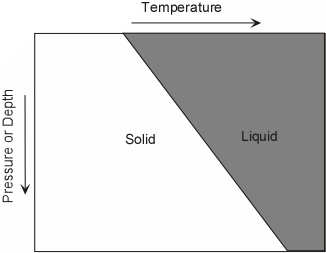
  1. If the mineral contains no water (H2O) or carbon dioxide (CO2) and there is no water or carbon dioxide present in the surroundings, then melting occurs at a single temperature at any given pressure and increases with increasing pressure or depth in the Earth.  This is called dry melting.
DryMin.GIF (5361 bytes)
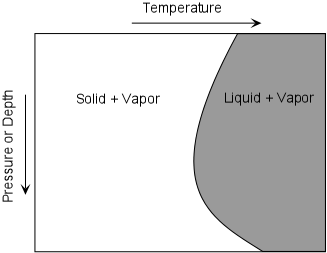
  1. If water or carbon dioxide are present within or surrounding the mineral, then melting takes place at a single temperature at any given pressure, but first decreases with increasing pressure
WetMinMelt.GIF (5904 bytes)


Since rocks are mixtures of minerals, they behave somewhat differently.  Unlike minerals, rocks do not melt at a single temperature, but instead melt over a range of temperatures.  Thus, it is possible to have partial melts, from which the liquid portion might be extracted to form magma.  The two general cases are:
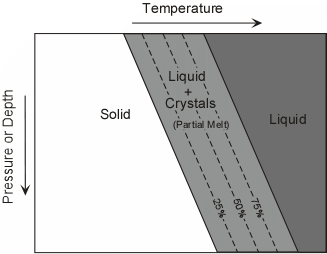
  1. Melting of dry rocks is similar to melting of dry minerals, melting temperatures increase with increasing pressure, except there is a range of temperature over which there exists a partial melt.  The degree of partial melting can range from 0 to 100%.
DryRockMelt.GIF (9815 bytes)
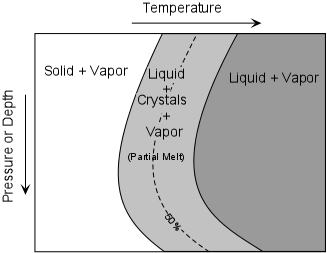
  1. Melting of wet rocks is similar to melting of wet minerals, except there is range of temperature range over which partial melting occurs.  Again, the temperature of beginning of melting first decreases with increasing pressure or depth, then at high pressure or depth the melting temperatures again begin to rise.
WetRockMelt.GIF (9309 bytes)


Origin of Basaltic Magma
 

Much evidence suggests that Basaltic magmas result from dry partial melting of mantle.

  • Basalts make up most of oceanic crust and only mantle underlies the crust.
  • Basalts contain minerals like olivine, pyroxene and plagioclase, none of which contain water.
  • Basalts erupt non-explosively, indicating a low gas content and therefore low water content.

The Mantle is made of garnet peridotite (a rock made up of olivine, pyroxene, and garnet) -- evidence comes from pieces brought up by erupting volcanoes. In the laboratory we can determine the melting behavior of garnet peridotite.

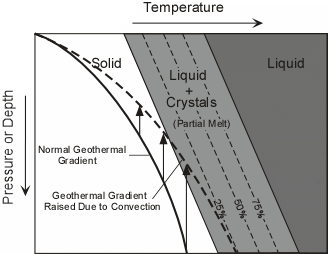
Under normal conditions the temperature in the Earth, shown by the geothermal gradient, is lower than the beginning of melting of the mantle.  Thus, in order for the mantle to melt there has to be a mechanism to raise the geothermal gradient.  One such mechanism is convection, wherein hot mantle material rises to lower pressure or depth, carrying its heat with it.  This causes the local geothermal gradient to rise, and if  the new geothermal gradient becomes higher than the initial melting temperature at any pressure, then a partial melt will form.  Liquid from this partial melt can be separated from the remaining crystals because, in general, liquids have a lower density than solids.  Basaltic magmas appear to originate in this way.   This is sometimes referred to as decompression melting. DecompMelt.GIF (14376 bytes)

Origin of Rhyolitic Magma

Most rhyolitic magma appears to result from wet melting of continental crust. The evidence for this is:

  • Most rhyolites are found in areas of continental crust.
  • When most rhyolitic magma erupts from volcanoes it does so very explosively, indicating high gas content.
  • Solidified rhyolite contains quartz, feldspar, hornblende, biotite, and muscovite. The latter minerals contain water, indicating high water content.

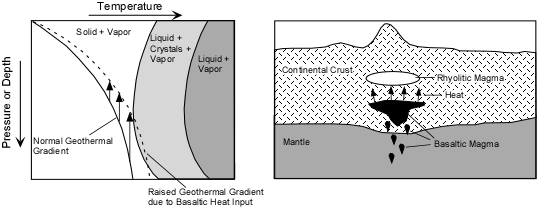
Still, the temperature in continental crust is usually not high enough to cause the melting of the crust.  Thus another heat source is necessary.  In most cases it appears that this heat source is basaltic magma.  The basaltic magma is generated in the mantle, as discussed above, then rises into the continental crust.  But, because basaltic magma has a high density it sometimes stops in the crust and crystallizes, releasing its heat into the surrounding crustal rocks.  This raises the local geothermal gradient, and may cause wet partial melting of the crust to produce rhyolitic magmas (crustal rocks generally contain water, either in pore spaces or minerals in the rocks).

Rhyolitic magma can also be produced by changing the chemical composition of basaltic magma as discussed later.

CrustalMelting.GIF (16346 bytes)

 Origin of Andesitic Magma

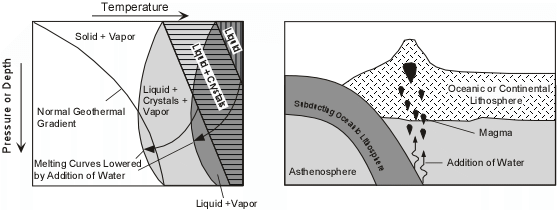
Andesitic magmas erupt in areas above subduction zones.  This suggests a relationship between the production of andesitic magma and subduction. An earlier theory suggested the wet partial melting of  subducted oceanic lithosphere, but newer theories suggest that it is wet partial melting of mantle. Since the oceanic lithosphere is in contact with ocean water there should be much water in the pore spaces of upper oceanic crustal rocks as well as water contained within clay minerals that have settled to the sea floor.  When this material is subducted, it begins to heat up and water is driven off.  If the water enters the overlying asthenospheric mantle, it will lower its melting temperatures and thus melting will occur.  This melting will produce basaltic magmas with high water content.   Other processes, discussed below, are necessary to change this basaltic magma to andesitic magma


Changes in Magma Composition

Basaltic magmas can undergo change as they pass trough the earth's crust, particularly if they pass through the thicker and more siliceous contintental crust.   If the crust gets hot enough, it can melt, as discussed above, and this siliceous melt can mix with the basaltic magma to make an intermediate andesitic magma. 

Crystal Fractionation

When magma solidifies to form a rock it does so over a range of temperature. Each mineral begins to crystallize at a different temperature, and if these minerals are somehow removed from the liquid, the liquid composition will change. Depending on how many minerals are lost in this fashion, a wide range of compositions can be made. The processes is called magmatic differentiation by crystal fractionation.

Crystals can be removed by a variety of processes. If the crystals are more dense than the liquid, they may sink. If they are less dense than the liquid they will float. If liquid is squeezed out by pressure, then crystals will be left behind. Removal of crystals can thus change the composition of the liquid portion of the magma. Let me illustrate this using a very simple case.

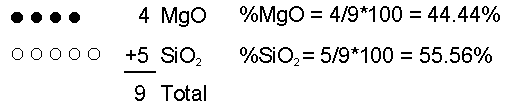
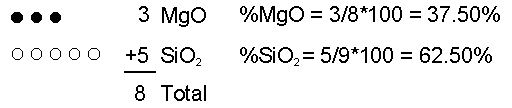
Imagine a liquid containing 5 molecules of MgO and 5 molecules of SiO2. Initially the composition of this magma is expressed as 50% SiO2 and 50% MgO. i.e.

Now let's imagine I remove 1 MgO molecule by putting it into a crystal and removing the crystal from the magma. Now what are the percentages of each molecule in the liquid?


If we continue the process one more time by removing one more MgO molecule

Thus, composition of liquid can be changed.  This process is called crystal fractionation.  A mechanism by which a basaltic magma beneath a volcano could change to andesitic magma and eventually to rhyolitic magma through crystal fractionation, is provided by Bowen's reaction series, discussed next.

Bowen's Reaction Series
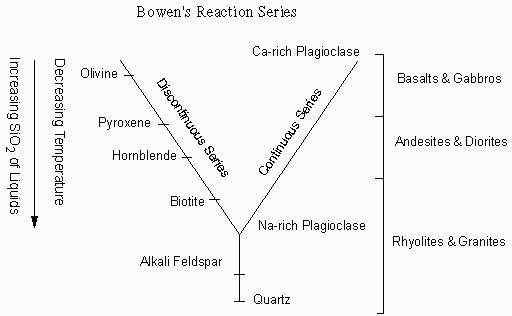
Bowen found by experiment that the order in which minerals crystallize from a basaltic magma depends on temperature.  As a basaltic magma is cooled Olivine and Ca-rich plagioclase crystallize first.  Upon further cooling, Olivine reacts with the liquid to produce pyroxene and Ca-rich plagioclase react with the liquid to produce less Ca-rich plagioclase.  But, if the olivine and Ca-rich plagioclase are removed from the liquid by crystal fractionation, then the remaining liquid will be more SiO2 rich.  If the process continues, an original basaltic magma can change to first an andesite magma then a rhyolite magma with falling temperature.

Volcanic Eruptions

  • In general, magmas that are generated deep within the Earth begin to rise because they are less dense than the surrounding solid rocks.

  • As they rise they may encounter a depth or pressure where the dissolved gas no longer can be held in solution in the magma, and the gas begins to form a separate phase (i.e. it makes bubbles just like in a bottle of carbonated beverage when the pressure is reduced).

  • When a gas bubble forms, it will also continue to grow in size as pressure is reduced and more of the gas comes out of solution.  In other words, the gas bubbles begin to expand.

  • If the liquid part of the magma has a low viscosity, then the gas can expand relatively easily.  When the magma reaches the Earth's surface, the gas bubble will simply burst, the gas will easily expand to atmospheric pressure, and a non-explosive eruption will occur, usually as a lava flow (Lava is the name we give to a magma when it on the surface of the Earth).

  • If the liquid part of the magma has a high viscosity, then the gas will not be able to expand very easily, and thus, pressure will build up inside of the gas bubble(s).  When this magma reaches the surface, the gas bubbles will have a high pressure inside, which will cause them to burst explosively on reaching atmospheric pressure.  This will cause an explosive volcanic eruption.

Nonexplosive Eruptions
Non explosive eruptions are favored by low gas content and low viscosity magmas (basaltic to andesitic magmas).

  • If the viscosity is low, nonexplosive eruptions usually begin with fire fountains due to release of dissolved gases.
  • Lava flows are produced on the surface, and these run like liquids down slope, along the lowest areas they can find.
  • Lava flows produced by eruptions under water are called pillow lavas.
  • If the viscosity is high, but the gas content is low, then the lava will pile up over the vent to produce a lava dome or volcanic dome.

Explosive Eruptions
Explosive eruptions are favored by high gas content and high viscosity (andesitic to rhyolitic magmas).

  • Explosive bursting of bubbles will fragment the magma into clots of liquid that will cool as they fall through the air.  These solid particles become pyroclasts (meaning - hot fragments) and tephra or volcanic ash, which refer to sand-  sized or smaller fragments.

Tephra and Pyroclastic Rocks

Average Particle Size (mm) Unconsolidated Material (Tephra) Pyroclastic Rock
>64 Bombs or Blocks Agglomerate
2 - 64 Lapilli Lapilli Tuff
<2 Ash Ash Tuff
  • Blocks are angular fragments that were solid when ejected.

  • Bombs have an aerodynamic shape indicating they were liquid when ejected.

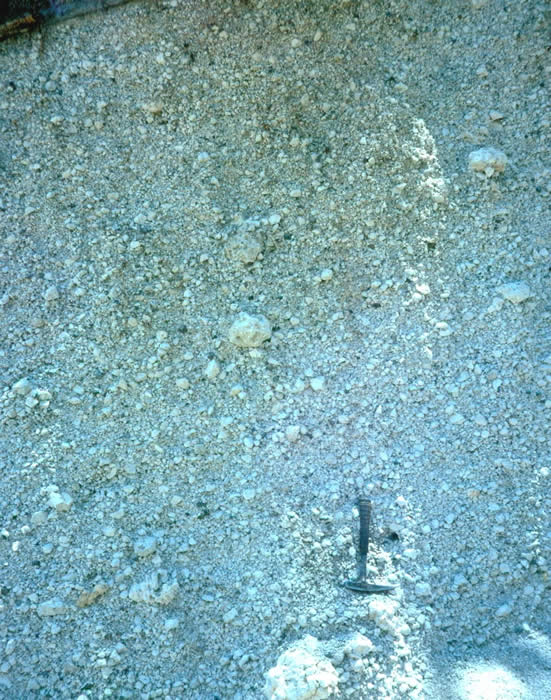
  • Bombs and lapilli that consist mostly of gas bubbles (vesicles) result in a low density highly vesicular rock fragment called pumice.
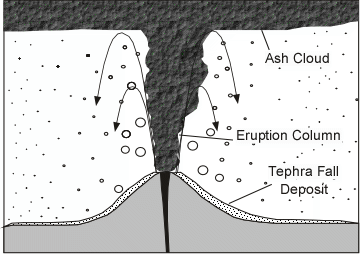
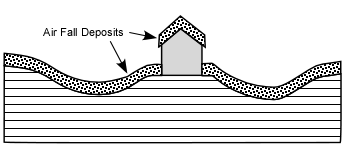
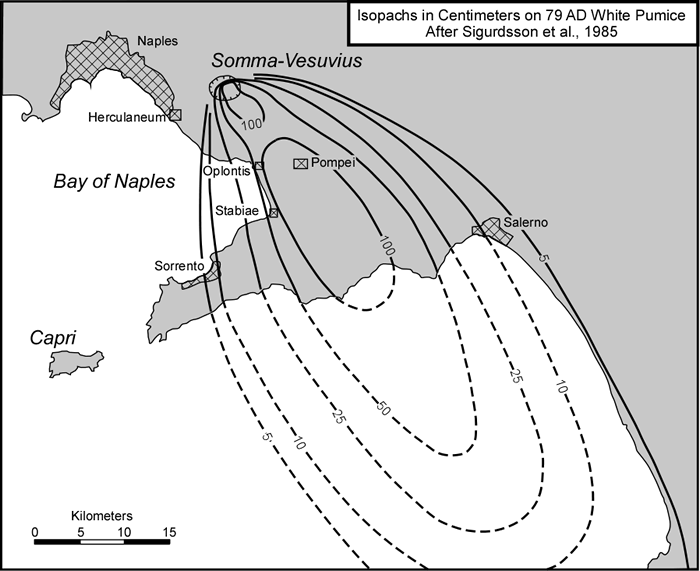
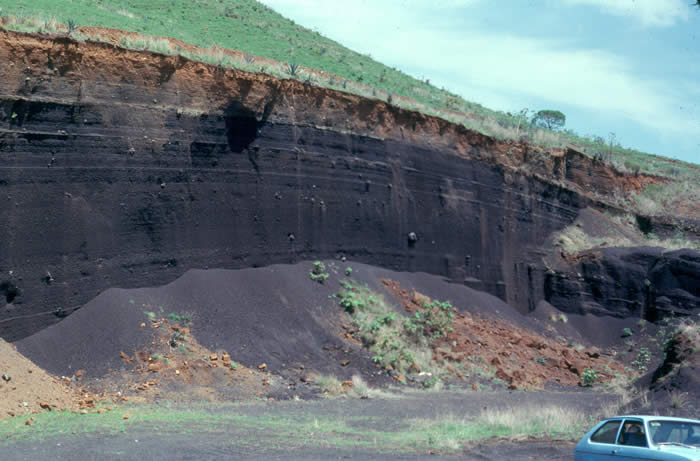
  • Clouds of gas and tephra that rise above a volcano produce an eruption column that can rise up to 45 km into the atmosphere. Eventually the tephra in the eruption column will be picked up by the wind, carried for some distance, and then fall back to the surface as a tephra fall or ash fall.
EruptColumn.GIF (17691 bytes)
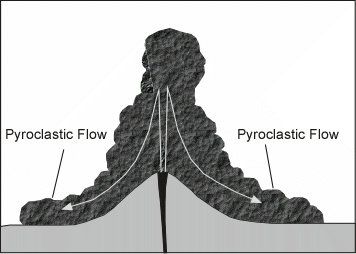
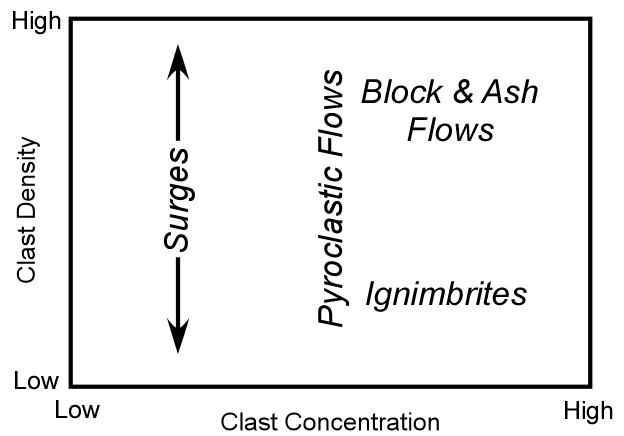
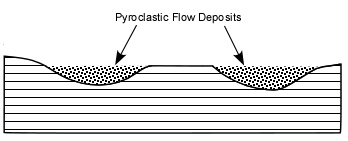
  • If the eruption column collapses a pyroclastic flow  will occur, wherein gas and tephra rush down the flanks of the volcano at high speed.  This is the most dangerous type of volcanic eruption.  The deposits that are produced are called ignimbrites if they contain pumice or pyroclastic flow deposits if they contain non-vesicular blocks.
PyroclasFlow.GIF (12927 bytes)


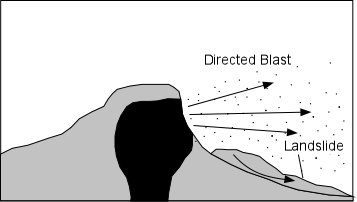
  • If the gas pressure inside the magma is directed outward instead of upward, a lateral blast can occur.  When this occurs on the flanks of a lava dome, a pyroclastic flows called a glowing avalanche or nuée ardentes (in French) can also result. Directed blasts often result from sudden exposure of the magma by a landslide or collapse of a lava dome.
DirectBlast.GIF (7505 bytes)


Types of Volcanic Eruptions

Volcanic eruptions, especially explosive ones, are very dynamic phenomena.  That is the behavior of the eruption is continually changing throughout the course of the eruption.  This makes it very difficult to classify volcanic eruptions.  Nevertheless they can be classified according to the principal types of behavior that they exhibit.  An important point to remember, however, is that during a given eruption the type of eruption may change between several different types.

  • Hawaiian - These are eruptions of low viscosity basaltic magma.  Gas discharge produces a fire fountain that shoots incandescent lava up to 1 km above the vent.  The lava, still molten when it returns to the surface flows away down slope as a lava flow.  Hawaiian Eruptions are considered non-explosive eruptions.  Very little pyroclastic material is produced.

  • Strombolian - These eruptions are characterized by distinct blasts of basaltic to andesitic magma from the vent.  These blasts produce incandescent bombs that fall near the vent, eventually building a small cone of tephra.  Sometimes lava flows erupt from vents low on the flanks of the small cones.  Strombolian eruptions are considered mildly explosive, and produce low elevation eruption columns and tephra fall deposits. 

  • Vulcanian - These eruptions are characterized by sustained explosions of solidified or highly viscous andesite or rhyolite magma from a the vent.  Eruption columns can reach several km above the vent, and often collapse to produce pyroclastic flows.  Widespread tephra falls are common.  Vulcanian eruptions are considered very explosive.

  • Pelean - These eruptions result from the collapse of an andesitic or rhyolitic  lava dome, with or without a directed blast, to produce glowing avalanches or nuée ardentes, as a type of pyroclastic flow known as a block-and-ash flow.  Pelean eruptions are considered violently explosive.

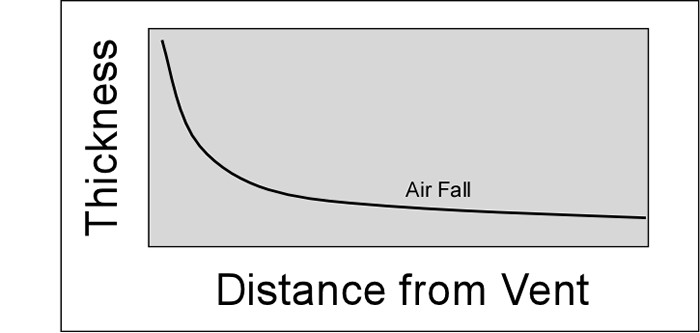
  • Plinian - These eruptions result from a sustained ejection of andesitic to rhyolitic magma into eruption columns that may extend up to 45 km above the vent.  Eruption columns produce wide-spread fall deposits with thickness decreasing away from the vent, and exhibit eruption column collapse to produce pyroclastic flows.  Plinian ash clouds can circle the Earth in a matter of days. Plinian eruptions are considered violently explosive.

  • Phreatomagmatic - These eruptions are produced when magma comes in contact with shallow groundwater causing the groundwater to flash to steam and be ejected along with pre-existing fragments of the rock and tephra from the magma.  Because the water expands so rapidly, these eruptions are violently explosive although the distribution of pyroclasts around the vent is much less than in a Plinian eruption.

  • Phreatic (also called steam blast eruptions) - result when magma encounters shallow groundwater, flashing the groundwater to steam, which is explosively ejected along with pre-exiting fragments of rock.  No new magma reaches the surface.


Return to EENS 204 Homepage