Shield Volcanoes
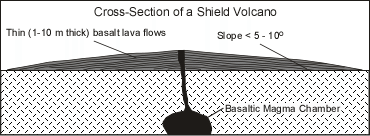
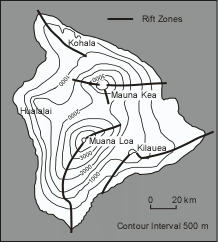
- A shield volcano is characterized by gentle upper slopes (about 5o)
and somewhat steeper lower slopes (about 10o).
| EENS 3050 | Natural Disasters |
| Tulane University | Prof. Stephen A. Nelson |
Volcanic Landforms, Volcanoes and Plate Tectonics |
|
Volcanic landforms are controlled by the geological processes that form
them and act on them after they have formed. Thus, a given volcanic landform will be
characteristic of the types of material it is made of, which in turn depends on the prior
eruptive behavior of the volcano. Although later processes can modify the original
landform, we should be able to find clues in the modified form that lead us to conclusions
about the original formation process. Here we discuss the major volcanic landforms
and how they are formed, and in some cases, later modified. Most of this material
will be discussed with reference to slides shown in class that illustrate the essential
features of each volcanic landform. |
Shield Volcanoes
|
|
|
|
 |
Stratovolcanoes (also called Composite Volcanoes)
|
|
 |
|
Cinder Cones(also called Tephra Cones)
|
|
 |
|
Maars
|
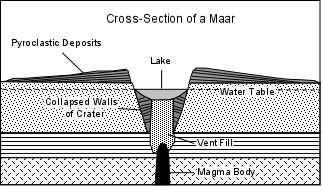 |
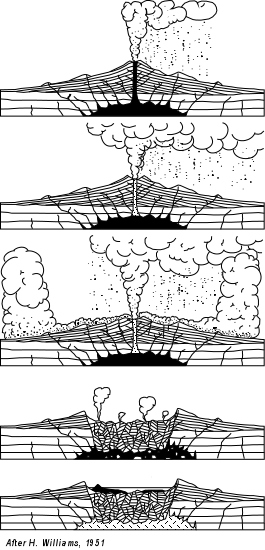
Parts of the crater walls eventually collapse back into the crater, the vent is filled with loose material, and, if the crater still is deeper than the water table, the crater fills with water to form a lake, the lake level coinciding with the water table. |
Volcanic Domes (also called Lava Domes)
|
|
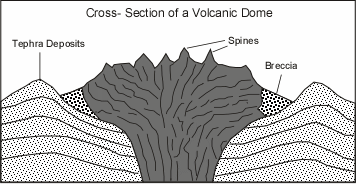 |
|
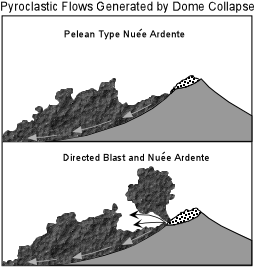 |
Craters and Calderas
|
|
|
|
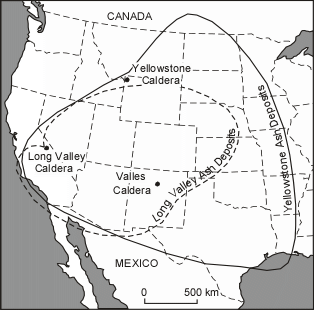 |
|
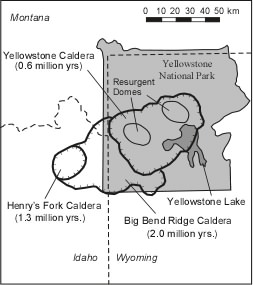 |
|
|
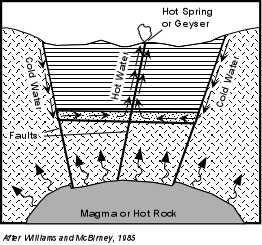
Geysers, Fumaroles and Hot Springs |
|
|
 |
|
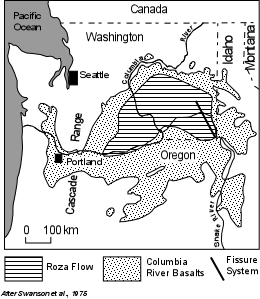
Plateau Basalts or Flood Basalts
|
|
 |
Global Distribution of Volcanoes In the discussion we had last lecture about how magmas form, we pointed out that since the upper parts of the Earth are solid, special conditions are necessary to form magmas. These special conditions do not exist everywhere beneath the surface, and thus volcanism does not occur everywhere. If we look at the global distribution of volcanoes we see that volcanism occurs four principal settings. |
|
|
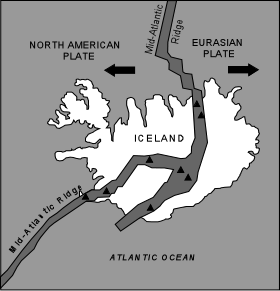
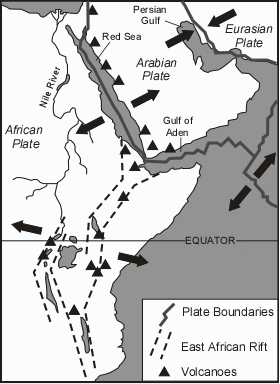
| Diverging Plate Margins Active volcanism is currently taking place along all of oceanic ridges, but most of this volcanism is submarine volcanism and does not generally pose a threat to humans. |
|
|
 |
|
 |
|
| Converging Plate Margins | |
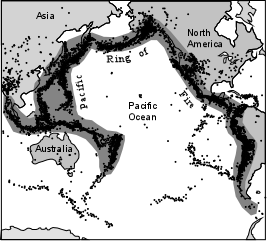
All around the Pacific Ocean, is a zone often referred to as the Pacific Ring of Fire, where most of the world's most active and most dangerous volcanoes occur. The Ring of Fire occurs because most of the margins of the Pacific ocean coincide with converging margins along which subduction is occurring |
 |
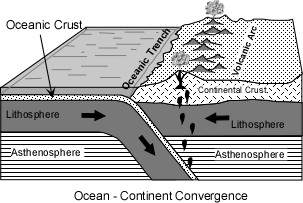
The convergent boundary along the coasts of South America, Central America, Mexico, the northwestern U.S. (Northern California, Oregon, & Washington), western Canada, and eastern Alaska, are boundaries along which oceanic lithosphere is being subducted beneath continental lithosphere. This has resulted in the formation of continental volcanic arcs that form the Andes Mountains, the Central American Volcanic Belt, the Mexican Volcanic Belt, the Cascade Range, and the Alaskan volcanic arc. |
 |
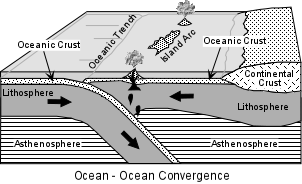
The Aleutian Islands (west of Alaska), the Kurile-Kamchatka Arc, Japan, Philippine Islands, and Marianas Islands, New Zealand, and the Indonesian Islands, along the northern and western margins of the Pacific Ocean are zones where oceanic lithosphere is being subducted beneath oceanic lithosphere. These are all island arcs. |
 |
|
Hot Spots |
|
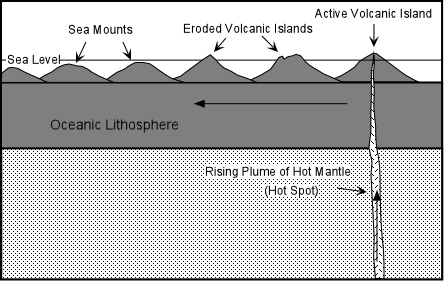
Volcanism resulting from hotspots occurs in both the Atlantic and Pacific ocean, but
are more evident on the sea floor of the Pacific Ocean, because the plates here move at
higher velocity than those under the Atlantic Ocean. A hot spot trace shows up as a
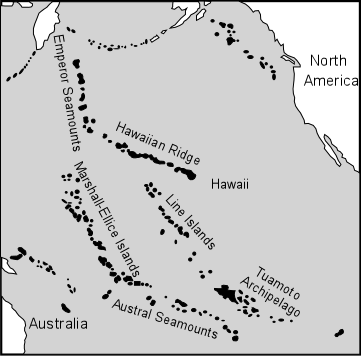
linear chain of islands and seamounts, many of which can be seen in the Pacific Ocean.
The Hawaiian Ridge is one such hot spot trace. Here the Big Island of Hawaii
is currently over the hot spot, the other Hawaiian islands still stand above sea level,
but volcanism has ceased. Northwest of the Hawaiian Islands, the volcanoes have
eroded and are now seamounts. The ages of volcanic rocks increase along the Hawaiian Ridge to the northwest of
Hawaii. The prominent bend observed where the Hawaiian Ridge intersects the Emperor
Seamount chain has resulted from a change in the direction of plate motion over the hot
spot. Note that when the Emperor Seamount chain was produced, the plate must have
been moving in a more northerly direction. The age of the volcanic rocks at the bend
is about 50 million years. |
Yellowstone appears to be over a continental hot spot that has produced a chain of volcanoes as the North American Plate moves southwestward over the hot spot. (see figure 6.38 in your text) |
Examples of questions on this material that could be asked on an exam
|