| EENS 204 | Natural Disasters |
| Tulane University | Prof. Stephen A. Nelson |
Volcanic Case Histories |
|
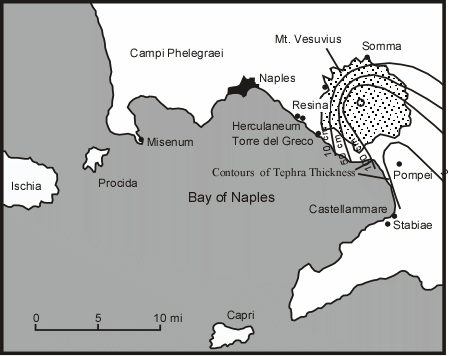
In this lecture we will discuss three case histories of important eruptions that have occurred within recorded history. The eruption of Mount Vesuvius, Italy in 79 A.D., the eruption of Mount Pelée on the Caribbean island of Martinique in 1902, and the eruption of Mount St. Helens on May 18, 1980. Vesuvius, 79 A.D. Mount Vesuvius is located to the southeast of Naples, Italy along the Bay
of Naples. Prior to the catastrophic eruption of 79 A.D. Vesuvius was considered an
extinct volcano by the inhabitants of the area, who were flourishing at the height of the
Roman Empire. The area northwest of Naples, known as the Phelegrean Fields, was
known to be an active volcanic area, however. Nevertheless, when earthquakes
became frequent in the Vesuvius area in 62 A.D., they caused no alarm because earthquakes
were quite common throughout Italy. |
|
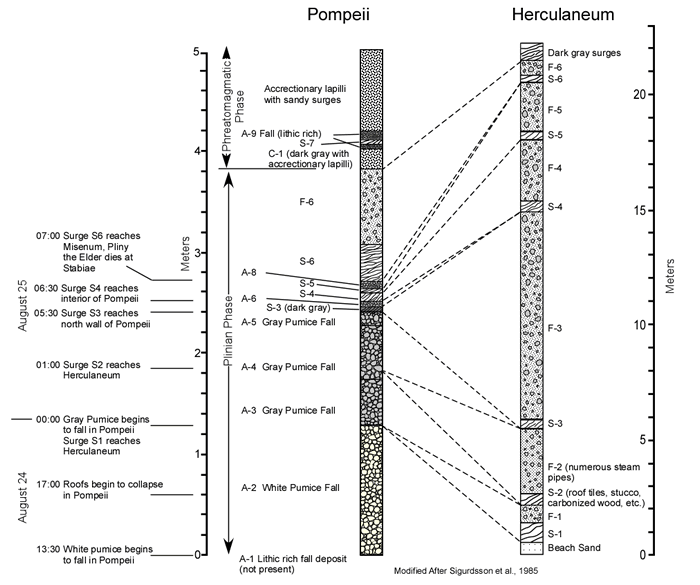
| What we know of the eruption that took place in 79 A.D. comes from two
different sources: (1) Two letters written by the Pliny the Younger, the nephew of
Caius Plinius (Pliny the Elder), to the historian Tacitus concerning the death of his
uncle. Pliny the Elder was an admiral in the Roman navy and well known in his
time. (2) Information from geological and archeological studies that have examined
the area around Vesuvius.
|
![]() |
| We start with the account given by Pliny the Younger in his letters to Tacitus. About
1 P.M. on August 24, 79 A.D. the Plinys were in Misenum, about 30 km across the Bay of
Naples from Vesuvius. A large cloud appeared above the volcano, growing rapidly,
rising many thousands of meters and spreading out laterally in the atmosphere.
Pliny
the Younger states that the cloud had the shape of a Mediterranean pine tree, with a
narrow trunk at the base, spreading out like branches above. Pliny the Elder was
curious about the cloud and began to plan a trip across the bay to
investigate. Before he
could get his ship ready, he received word from people living closer to Vesuvius that
people needed help, and his investigative mission became instead a rescue mission.
He organized his fleet and set sail with the intention of rescuing people living near the
base of the volcano at Torre del Greco. As he crossed the bay his ship was showered
by hot ashes and pumice which accumulated on the deck. He soon found it was
impossible to make the rescue attempt and he turned in the direction of the wind and
instead landed at Stabiae, to the south of Vesuvius. At Stabiae, conditions were
still mild and he encountered his friend Pomponianus who was trying to escape to the sea,
but the winds were not favorable. In order to reassure Pomponianus that there was no
danger, Pliny went to the local baths and sat down for a meal.
As night came, Pliny
retired for several hours of sleep. During his sleep tephra began piling up in the
courtyard of the house and earthquakes and loud explosions occurred in the area of
Vesuvius. Pliny awakened by the trembling and loud noises and conferred with Pomponianus. They decided that their best escape was to go to the shore and try to
leave by ship. They tied pillows to their heads for safety from the falling pumice,
but darkness enveloped the area as a result of the falling tephra, and it remained dark
even after the sun should have come up. They eventually made it to the shore, but
found that the wind was not blowing in a direction favorable to sail away from the area.
Suddenly Pliny the Elder began to feel poorly. He laid down on a cloth near
the shore and asked for water twice. Then sulfurous fumes descended on the area
making staying put an unpleasant experience. Pliny rose to move away from the area,
but fell dead. His friends thought that he had been poisoned by the fumes, but no
one else was affected. His friends all later escaped. Three days later Pliny's
body was found, unmarked by any damage. It is highly unlikely that Pliny died of
poisoning from the fumes because Stabiae is so far from Vesuvius; it is more likely
that he died from a heart attack resulting from his physical exertion in attempting to
flee the falling ash. On the same morning that Pliny the Elder died, his wife and
nephew were still in Misenum. Conditions there were also growing worse.
Although Misenum was upwind from the volcano, there were still frequent earthquakes and
the sky filled with ash and became dark. Pliny the Younger and his mother decided to
leave their house and move farther away from the volcano. They set off in chariots,
but the shaking of the ground and the accumulation of ash soon made it impossible to
continue. They observed sharp retreats in the sea, followed by waves that crashed
high on the shore, probably due to tsunamis as pyroclastic flows from Vesuvius entered the
sea. They attempted to move farther inland, but soon the ash from the eruption
became so thick that they were engulfed in total darkness. Pliny the Younger
compared the darkness to that of a sealed room with no source of light. This lasted
for many hours, but eventually the air cleared and they were able to observe Vesuvius in
the distance. What had once been a smooth gentle mountain was now seen to be reduced
in size by about one half, and what once had been lush vineyards in the countryside
surrounding the mountain was now a plain of gray colored ash mantling the countryside like
snow. |
The account given by Pliny the Younger says nothing about what
happened to the towns of Pompeii and Herculaneum, close the volcano. But his account
of the "pine tree" like cloud above the volcano was the first description of an
eruption column, and thus volcanic eruptions that produce eruption columns and fall
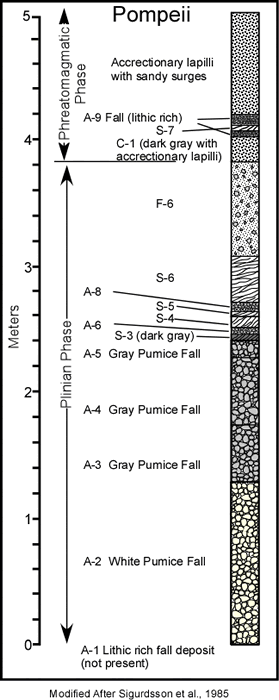
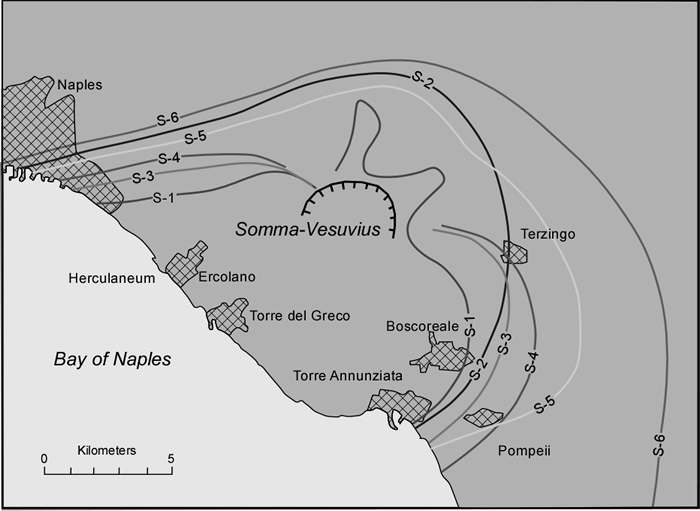
deposits have taken on his and his uncle's name, and are referred to as Plinian eruptions. The fate of Pompeii and Herculaneum had to await further exploration by
geologists and archeologists. Note that Pompeii was located about nine kilometers
down wind from Vesuvius, and was buried by close to 3 meters of tephra that had fallen
from the eruption cloud. Since the eruption killed most of the inhabitants of
Pompeii it remained abandoned for hundreds of years. In 1595 some of the ruins of
Pompeii were discovered when excavation for a new aqueduct began. Coins were found, along
with marble tablets with inscriptions referring to Pompeii. People then began the
unsystematic excavation of parts of the former city in search of buried works of art and
other treasures. In the 1800s true archeological excavations began to uncover the
buried city in a more systematic way. The pumice that had buried the city was dug
away to reveal a well preserved instant in time. It appears that disaster came
rapidly, as food laid out in some houses showed that life must have continued much as
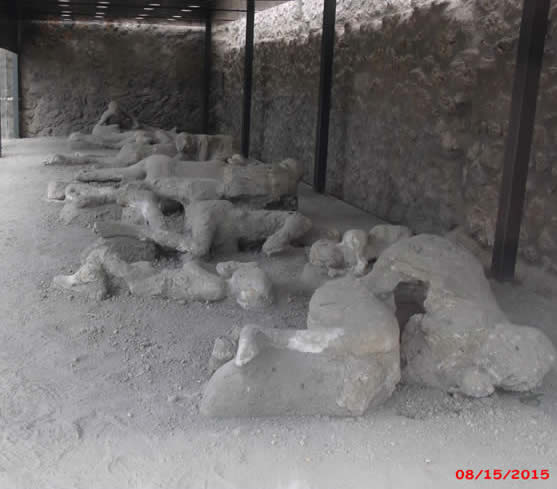
normal until the end. Many human fossils were found. The bodies had been
buried in ash and rain falling on the ash had cemented it together to form molds around
the bodies before they decayed. After the bodies decayed an open cavity was
preserved and archeologists made plaster of paris casts of these cavities to reveal
remarkable detail about the last moments of Pompeii (see figures in your text).
Many of the bodies showed that the victims had likely died of asphyxiation from breathing
the hot gas and dust. Their hands were clenched around their mouths probably in an
attempt to filter out the dust prior to their deaths. Many corpses were found
clutching bags of gold that they had gathered in an attempt to flee. Although some
people likely died as their roofs collapsed due to the weight of the accumulating tephra,
geological evidence indicates that their were periodic blasts of ash coming from the
volcano that produced pyroclastic flows. These were likely the major cause of death. The destruction of Herculaneum was somewhat different. Herculaneum
was located on the shore of the Bay of Naples at the base of Mount Vesuvius.
Herculaneum has not been excavated to the extent of Pompeii because the modern city of
Resina is built on top of it. Herculaneum was buried by different kinds of deposits
than was Pompeii. Instead of loose tephra fall deposits, Herculaneum was buried by a
highly unsorted mixture of rock fragments and fine-grained tephra that became much more
consolidated into a hard rock after deposition. Such consolidation makes excavation
much more difficult at Herculaneum. Early geologic investigations suggested that
these deposits were mudflows or lahars, but more recent investigations show that they are
instead deposits of pyroclastic flows. Within the 8 square blocks of Herculaneum
that have been excavated, it first appeared that most of the residents had escaped death
before the advance of the pyroclastic flows. But recent excavations near the
shoreline have found buildings supported by arched chambers open to the beach.
Within these chambers hundreds of skeletons were found. Thus it is likely that the
residents ran to these buildings for shelter from the volcano, but were eventually
engulfed in the pyroclastic flows and died. Although Vesuvius has been intermittently active throughout the years
since the 79 A.D. disaster, the population has returned to the Vesuvius area and Naples
and its suburbs is one of the largest modern cities built in the danger zone of an active
volcano.
|
Mt. Pelée, Martinique, 1902 |
|
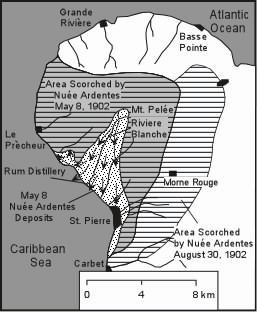
Mount Pelée is a volcano on the northern part of the French Caribbean Island of Martinique. The city of St. Pierre lies about 6km to the southwest of the volcanic peak on the shores of the Caribbean Sea. Prior to 1902, the last eruption from the volcano had occurred in 1851. Below is a chronology of events leading up to and including the devastating eruption that took place on May 8, 1902.
|
![]() |
This eruption is an extremely important event because it was the first
time that the scientific community became aware of the phenomena of pyroclastic flows. |
The video on Mount St. Helens is spectacular. The following are the major points of the events leading to the eruption, the eruption itself, and following the eruption, shown in the video. There will likely not be enough time to discuss these points in class. The last portion of the video discusses the prediction of dome eruptions that have taken place since the May 18 eruption and was discussed in the previous lecture. In a 1975 volcanic hazards study of Mount St. Helens, U.S. Geological Survey geologists D.R. Crandell, D. Mullineaux and M. Rubin noted that Mount St. Helens had been built within the last 2,500 years with the last eruption in 1857. Major eruptions had occurred every hundred years or so and St. Helens was one of the most active volcanoes in the Cascade Range. In their paper they stated that Mount St. Helens "will erupt again in the next 100 years, perhaps before the end of the century." |
|
Mount St. Helens did reawaken on March 21, 1980 when a magnitude 4.2 earthquake occurred beneath the volcano. Earthquakes continued until March 27 when a phreatic eruption occurred at the summit. Similar small eruptions took place through mid April and the summit of the mountain developed a new crater due to the explosions. Note that only pre-existing rock fragments were ejected during these initial eruptions. By mid-April volcanic tremor had begun beneath the mountain indicating the movement of magma. By the end of April surveys showed that the north face of the mountain above an older volcanic dome, known as the Goat Rocks Dome, had begun to bulge upwards and outwards at rates up to 1 m per day. By May 12, the bulge had displaced parts of the northern part of the volcano a distance of about 150 m. Geologists now recognized that this bulge could soon develop into a landslide, but were uncertain when or if it would occur and how big the slide would be. Most of the area in the danger zone (called the red zone) had been evacuated, but intense pressure from people with cabins and homes within the red zone forced the Governor of Washington to open the area to allow land owners to return under police supervision to retrieve their belongings. The first of these escorted entries into the red zone took place on May 17, and a second caravan was scheduled for the morning of May 18. Fortunately the latter expedition was not scheduled to leave until 9:00 A.M. |
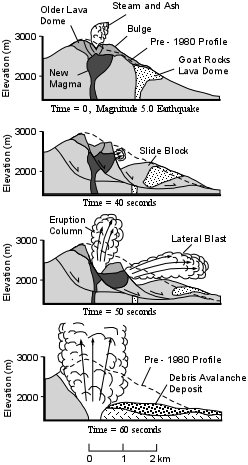
| At 8:32 AM on May 18, 1980 a magnitude 5.0 earthquake occurred beneath Mt. St.
Helens. This led to a violent eruption that took place over about the next
minute. The earthquake triggered a large landslide that began to slide out to the
north, initially as three large blocks. As the first block, containing the old Goat
Rocks lava dome, began to slide downward, the magma chamber beneath the volcano became
exposed to atmospheric pressure. The gas inside the magma expanded rapidly,
producing a lateral blast that moved outward toward the north. As the second slide
block began to move downwards a vertical eruption column began to form above the
volcano. The lateral blast rapidly overtook the slide block and roared through an
area to the north of the mountain, knocking down all trees in its path and suffocating all
living things, including humans. Within the next 10 seconds the third slide block
moved out toward the north. All slide blocks banked up against the mountain north of
Spirit Lake and were then diverted down the North Fork of the Toutle River valley toward
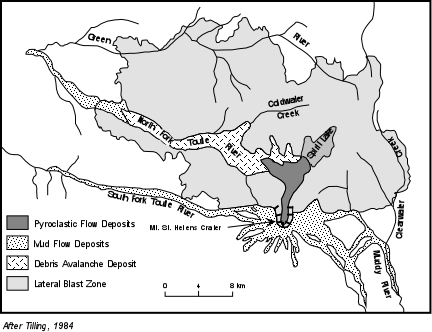
the west, breaking up into smaller blocks as they moved down slope. The landslide
thus became a debris avalanche and left a deposit extending about 20 km down the valley
(see map below). The southern shores of Spirit Lake were displaced about 1 km northward
and the level of the lake was raised about 40 m. Harry Truman's Lodge was buried by
the debris avalanche. |
![]() |
| Within about the first minute of the eruption the lateral blast had ceased, the debris
avalanche had been deposited, and the summit of Mount St. Helens had been reduced by about
500 m. The magma however continued to erupt in a Plinian eruption column that
reached up to 26 km into the atmosphere. The eruption column collapsed several times
to produce pyroclastic flows that moved into Spirit Lake and the upper reaches of the
Toutle River Valley. This Plinian phase lasted about 9 hours and spread tephra in a
plume to the east, darkening the area at midday to make it appear like night. During this first minute of the eruption everything within the lateral blast zone had been knocked down and covered with a thin layer of ash. Trees along about a 100 m wide zone surrounding the blast zone had been stripped of their vegetation or severely singed to a brownish color. In all, 62 people lost their lives, either by being buried by the debris avalanche deposit, or suffocating by breathing the hot gases and dust of the blast. Some also died in the cars or trucks when pieces of wood were driven through the cars by the blast. Over the next several days melted snow combined with the new ash to produce mudflows that roared down the North and South Forks of the Toutle River and drainages to the south of the volcano. |
| Logs were carried into the Columbia River and so much sediment accumulated in the shipping channel of the Columbia River that it cost several hundred million dollars to dredge the channel and remove the logs so that shipping could continue. Eastern Washington was covered in volcanic ash for months after the eruption and relief efforts were slow. Although the tephra fall deposits that accumulated in eastern Washington were anticipated by the prior volcanic hazards study, most planning for rescue and recovery had concentrated on the area immediately around Mount St. Helens. |
![]() |
| In general, the eruption had been much larger than most anticipated, but the fact that
a hazards study had been carried out, that public officials were quick to act and evacuate
the danger zone, and that the volcano was under constant monitoring, resulted in the
minimization of loss of life to only 57 instead of a much larger number that could have
been killed had not these efforts been in place. Since the 1980 eruption, several volcanic domes have been emplaced in the crater and some have been blasted out. In the future, it is expected that new domes will continue to form, eventually building the volcano back to a form that will look more like it did prior to the 1980 eruption. |