| Protozoology Home | Course Syllabus | Other Courses and Lectures | Wiser Home |
MEDICAL PROTOZOOLOGY (TRMD 607)
This is a comprehensive course covering protozoa which infect humans. The basic biology of these protozoa, as well as the clinical manifestations of the diseases they cause, will be discussed. Life cycles, morphological features, host-parasite interactions, geographical distribution, reservoir hosts, methods of transmission and control, pathology, immunological aspects and diagnosis will be covered. The biological and clinical perspectives gained in this course will assist students in the recognition, evaluation and management of public health problems or clinical practice involving medically important protozoa.
Lectures are given on Wednesday and Friday afternoons during Session II at 1:00-3:00 of the fall semester (see class schedules for room assignment updates and call numbers and see campus map for location of Tidewater Building). This course follows the Medical Helminthology course in the same time slot.
| Lecture | Topics | Chapters |
|---|---|---|
| 1 | What are Protozoa? | 1 |
| Protozoan Cell and Molecular Biology | ||
| 2 | Giardiasis | 2,4 |
| Other lumenal protozoa (Trichomoniasis, Balantidiosis, Blastocystis, Dientamoeba) | 5-6 | |
| 3 | Amebiasis | 2-3 |
| 4 | African Trypanosomiasis | 7-8 |
| 5 | Chagas' Disease | 9 |
| 6 | Leishmaniasis | 10 |
| Midterm Exam | ||
| 7 | Plasmodium | 15 |
| Malaria | ||
| 8 | Pathophysiology of Malaria | |
| Epidemiology and Transmission of Malaria | ||
| Distinguishing Plasmodium species | ||
| 9 | Chemotherapy and Drug Resistance | |
| Babesia | 16 | |
| 10 | Coccidia | 12-13 |
| 11 | Toxoplasma and Sarcocytis | 14 |
| Free-Living Protozoa | 17 | |
| Intracellular Protozoa | 11 | |
| Comprehensive Final Exam |
Lecture links are to Study Guides. Chapters refer to the recommended textbook (Protozoa and Human Disease by Mark F. Wiser). Additional course related material and powerpoint files are available on Blackboard.
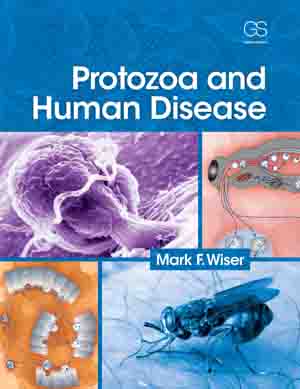
Recommended Textbook
Protozoa and Human Disease by Mark F. Wiser, Taylor and Francis Group. More information and ordering available from Garland Science and Amazon. Also available in Medical School Bookstore.
| Instructor: | Mark F. Wiser, Ph.D. |
| Room 2224 Tidewater | |
| 988-2507 | |
| wiser@tulane.edu | |
| Office Hours: |
Tues & Thurs 1:30-3:30 (or by appointment) |
Supplemental Texts on reserve in the Medical School Library located on the second floor of the Medical School (1430 Tulane Avenue).
Atlas of Human Parasitology, 4th edition, by Ash and Orihel. ASCP Press, 1997.
Color Atlas of Tropical Medicine and Parasitology by Peters and Gilles. Mosby-Wolfe, 1995.
Basic Clinical Parasitology, 6th ed. by Neva and Brown. Appleton & Lange, 1994.
Parasitic Diseases, 4th ed. by Despommier, Gwadz, Hotez and Knirsch. Apple Trees Production, 2000.
Human Parasitology, 2nd ed. by Bogitsh and Cheng. Academic Press, 1998.
Markell and Voge's Medical Parasitology, 8th ed. by Markell, John, and Krotoski. Saunders, 1999.
Protozoal Diseases, edited by Herbert M. Gilles. Oxford University Press, 1999.
Tropical Infectious Diseases: Principles, Pathogens, and Practice, by Guerrant, Walker, and Weller. Churchill Livingstone, 1999.
Essentials of Tropical Infectious Diseases, by Guerrant, Walker and Weller. Churchill Livingstone, 2001.
A midterm and a comprehensive final exam will be given over the lecture material. The format of these lecture exams will be multiple choice, true/false, fill-in-the-blank. Grading is as follows:
| Midterm Exam | 80 points | |
| Final Exam | 120 points |
| Protozoology Home | Course Syllabus | Other Courses and Lectures | Wiser Home |